
(Rounded off to two decimal places)
Average Speed Calculation for the Journey
To determine the average speed for the entire journey, we need to calculate the total distance covered and the total time consumed. The average speed is defined as the total distance divided by the total time.
The formula used is:
$ \text{Average Speed} = \frac{\text{Total Distance}}{\text{Total Time}} $
Calculating Time for Each Segment
The journey consists of two parts, each with a different distance and speed. We need to find the time taken for each part separately using the formula:
$ \text{Time} = \frac{\text{Distance}}{\text{Speed}} $
Segment 1: Distance and Speed
- Distance traveled ($d_1$) = 200 km
- Speed during this segment ($s_1$) = 50 km/hr
- Time taken for Segment 1 ($t_1$) is calculated as:
$ t_1 = \frac{d_1}{s_1} = \frac{200 \text{ km}}{50 \text{ km/hr}} = 4 \text{ hours} $
Segment 2: Distance and Speed
- Distance traveled ($d_2$) = 300 km
- Speed during this segment ($s_2$) = 60 km/hr
- Time taken for Segment 2 ($t_2$) is calculated as:
$ t_2 = \frac{d_2}{s_2} = \frac{300 \text{ km}}{60 \text{ km/hr}} = 5 \text{ hours} $
Calculating Total Journey Metrics
Next, we sum the distances and times from both segments to find the overall values for the journey:
- Total Distance ($D$) = $ d_1 + d_2 = 200 \text{ km} + 300 \text{ km} = 500 \text{ km} $
- Total Time ($T$) = $ t_1 + t_2 = 4 \text{ hours} + 5 \text{ hours} = 9 \text{ hours} $
Determining the Average Speed
Now, we apply the average speed formula using the calculated total distance and total time:
$ \text{Average Speed} = \frac{D}{T} = \frac{500 \text{ km}}{9 \text{ hours}} $
Performing the division:
$ \text{Average Speed} \approx 55.555... \text{ km/hr} $
Final Result Rounding
The question requires the answer to be rounded off to two decimal places.
Rounding $55.555...$ to two decimal places, we get $ \bf{55.56} $ km/hr.
So, the man's average speed for the entire journey is approximately 55.56 km/hr.
Important Questions from Speed Time & Distance (Notes)
- Ajay walks at a speed of 4 km/hr. He doubles his speed after reaching exactly half way. He walks for 12 hours in all. What is the total distance travelled by him ?
With a certain set of diameters, a tractor's front wheels make 2 revolutions (revs) for every 1 revolution of the rear wheels. The effect of changing wheel diameter(s) is shown in the following plot.
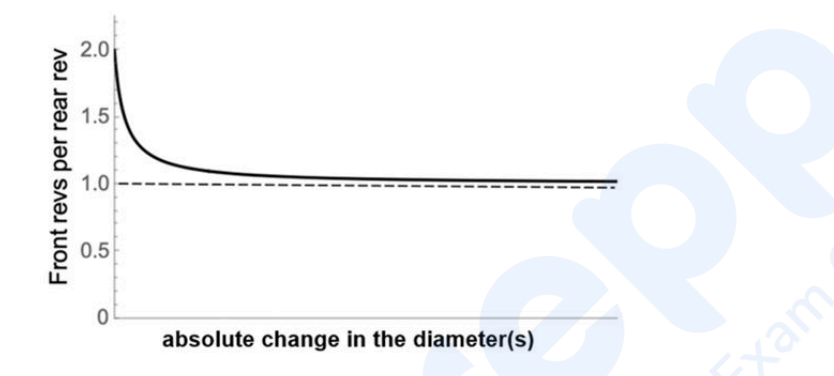
In this context, which of the following statements is CORRECT?- A train travels from Karnal to Kurukshetra at a speed of $90$ km/hr and returns at a speed of $92$ km/hr. If it takes $182$ hours for total travel, then find the distance between Karnal to Kurukshetra. (In Km)
A car covers 4 successive stretches of 3 km each at speed of 10 kmph, 20 kmph, 30 kmph and 60 kmph respectively. The average speed of the car for the entire journey is:
- A cyclist travels at 18 km/hr for 2.5 hours. What distance does he cover?


