
A long solenoid carries a steady current. An Amperian loop is chosen completely outside the solenoid. What is the magnetic field along this loop according to the ideal solenoid model?
Zero
In an ideal (infinitely long, tightly wound) solenoid, the magnetic field inside is uniform, \(B = \mu_0 n I\), directed along the axis.
For an Amperian loop lying entirely outside the solenoid, no current passes through the loop, so \(\oint \vec{B} \cdot d\vec{l} = \mu_0 I_{enc} = 0\). The field lines that leave one end return over an effectively infinite region, so the external field is taken as zero.
The other options fail: the field is maximum and uniform only inside the solenoid; outside it is neither equal to the inside value nor a uniform non-zero field in the ideal model.
Hence, the answer is Zero.
Similar Questions
The magnetic field inside a long solenoid is 4 × 10⁻³ T when it carries a current of 2 A. If the current is increased to 6 A, the magnetic field becomes:
An Amperian loop encloses three conductors carrying currents of 4 A, 3 A, and 1 A. Two currents are directed into the page and one is directed out of the page. Which additional information is required to determine the enclosed current?
Ampere's circuital law relates the line integral of the magnetic field around a closed path to:
Important Questions from Magnetostatics Ampere's Law Vector Potential
- Consider a particle of mass $m = 9.0 \times 10^{-5} \text{ kg}$ and charge $q = 3.0 \times 10^{-4} \text{ C}$ in a uniform electromagnetic field $\vec{E} = 2\hat{x} \text{ V.m}^{-1}$, $\vec{B} = 3\hat{z} \text{ V.m}^{-2}\text{.s}$. The particle is released from the coordinates $(0, 5\text{ m}, 0)$ at time $t = 0$. Starting from initial speed zero, it comes back to the $y$-axis for the first time at time $t$. The value of $t$ in seconds (rounded off to two decimal places) is _____
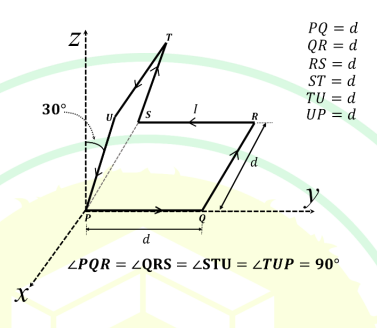
The wire loop shown in the figure carries a steady current $I$. Each straight section of the loop has length $d$. A part of the loop lies in xy plane and the other part is tilted at $30^\circ$ with respect to the xz plane. The magnitude of the magnetic dipole moment of the loop (in appropriate units) is
- A linear magnetic material in the form of a cylinder of radius $R$ and length $L$ is placed with its axis parallel to the $z$ axis. The cylinder has uniform magnetization $\vec{M} \hat{k}$. Which of the following option(s) is/are correct?
- Consider an isolated magnetized sphere of radius $R$ with a uniform magnetization $\vec{M}$ along the positive $z$ direction, with the north and south poles of the sphere lying on the $z$ axis. It is given that the magnetic field inside the sphere is $\vec{B} = \frac{2\mu_0}{3} \vec{M}$, where $\mu_0$ is the permeability of vacuum. Which of the following statements is(are) CORRECT?
An infinitely long cylinder of radius $R$ carries a frozen-in magnetization $\vec M = ke^{-s^2} \hat z$, where $k$ is a constant and $s$ is the distance from the axis of cylinder. The magnetic permeability of free space is $\mu_o$. There is no free current present anywhere. The magnetic flux density ($\vec B$) inside the cylinder is



