
The problem involves a linear magnetic material in the shape of a cylinder with uniform magnetization $\vec{M} = M \hat{k}$ along its axis.
Analysis of Options
Option A: Magnetic Field Outside Cylinder
For magnetostatic problems, the magnetic field $\vec{H}$ outside a magnetized object can often be derived from a magnetic scalar potential $\phi_m$, where $\vec{H} = -\nabla \phi_m$. This is because the bound currents (volume and surface) act as sources for the magnetic field, and in regions free of free currents, $\nabla \times \vec{H} = 0$ (if derived from magnetization currents). Therefore, the magnetic field outside the cylinder can be expressed as the gradient of a scalar function.
Conclusion: Option A is correct.
Option B: Bound Volume Current Density
The bound volume current density $\vec{J}_b$ is related to the magnetization $\vec{M}$ by:
$ \vec{J}_b = \nabla \times \vec{M} $
Given $\vec{M} = M \hat{k}$, where $M$ is a constant:
$ \nabla \times \vec{M} = \nabla \times (M \hat{k}) $
In Cartesian coordinates, $\nabla \times \vec{A} = (\frac{\partial A_z}{\partial y} - \frac{\partial A_y}{\partial z})\hat{i} + (\frac{\partial A_x}{\partial z} - \frac{\partial A_z}{\partial x})\hat{j} + (\frac{\partial A_y}{\partial x} - \frac{\partial A_x}{\partial y})\hat{k}$.
For $\vec{M} = M \hat{k}$, we have $M_x=0$, $M_y=0$, and $M_z=M$ (constant).
$ \frac{\partial M_z}{\partial y} = \frac{\partial M}{\partial y} = 0 $
$ \frac{\partial M_y}{\partial z} = \frac{\partial 0}{\partial z} = 0 $
Similarly, all other partial derivatives involving $M_x$, $M_y$, or $M_z$ are zero because $M$ is uniform.
Thus, $\vec{J}_b = 0 \hat{i} + 0 \hat{j} + 0 \hat{k} = \vec{0}$.
Conclusion: Option B is correct.
Option C: Surface Current Density on Curved Surface
The bound surface current density $\vec{K}_b$ on the surface of the magnetized material is given by:
$ \vec{K}_b = \vec{M} \times \hat{n} $
where $\hat{n}$ is the outward unit normal vector to the surface.
On the curved surface of the cylinder, the normal vector is radial, $\hat{n} = \hat{r}$.
$ \vec{K}_b = (M \hat{k}) \times \hat{r} $
Using the cross product rules in cylindrical coordinates ($\hat{k} \times \hat{r} = -\hat{\theta}$):
$ \vec{K}_b = -M \hat{\theta} $
Since $M$ is non-zero, $\vec{K}_b$ is non-zero on the curved surface.
Conclusion: Option C is correct.
Option D: Surface Current Densities on Flat Surfaces
On the flat top and bottom surfaces, the outward normal vectors are $\hat{n} = \hat{k}$ (top) and $\hat{n} = -\hat{k}$ (bottom).
For the top surface ($\hat{n} = \hat{k}$):
$ \vec{K}_b = \vec{M} \times \hat{n} = (M \hat{k}) \times \hat{k} = M (\hat{k} \times \hat{k}) = \vec{0} $
For the bottom surface ($\hat{n} = -\hat{k}$):
$ \vec{K}_b = \vec{M} \times \hat{n} = (M \hat{k}) \times (-\hat{k}) = -M (\hat{k} \times \hat{k}) = \vec{0} $
Thus, the surface current densities on the flat surfaces are zero.
Conclusion: Option D is incorrect.
Summary of Correct Options
Based on the analysis, the correct options are A, B, and C.
- A: The magnetic field at any point outside the cylinder can be expressed as the gradient of a scalar function.
- B: The bound volume current density is zero.
- C: The surface current density on the curved surface is non-zero.
Important Questions from Magnetostatics Ampere's Law Vector Potential
- Consider a particle of mass $m = 9.0 \times 10^{-5} \text{ kg}$ and charge $q = 3.0 \times 10^{-4} \text{ C}$ in a uniform electromagnetic field $\vec{E} = 2\hat{x} \text{ V.m}^{-1}$, $\vec{B} = 3\hat{z} \text{ V.m}^{-2}\text{.s}$. The particle is released from the coordinates $(0, 5\text{ m}, 0)$ at time $t = 0$. Starting from initial speed zero, it comes back to the $y$-axis for the first time at time $t$. The value of $t$ in seconds (rounded off to two decimal places) is _____
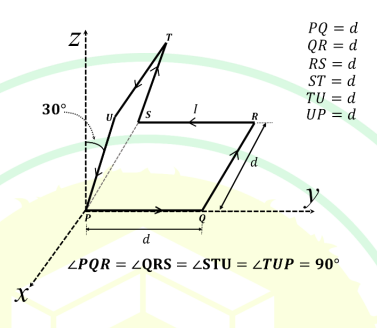
The wire loop shown in the figure carries a steady current $I$. Each straight section of the loop has length $d$. A part of the loop lies in xy plane and the other part is tilted at $30^\circ$ with respect to the xz plane. The magnitude of the magnetic dipole moment of the loop (in appropriate units) is
- Consider an isolated magnetized sphere of radius $R$ with a uniform magnetization $\vec{M}$ along the positive $z$ direction, with the north and south poles of the sphere lying on the $z$ axis. It is given that the magnetic field inside the sphere is $\vec{B} = \frac{2\mu_0}{3} \vec{M}$, where $\mu_0$ is the permeability of vacuum. Which of the following statements is(are) CORRECT?
An infinitely long cylinder of radius $R$ carries a frozen-in magnetization $\vec M = ke^{-s^2} \hat z$, where $k$ is a constant and $s$ is the distance from the axis of cylinder. The magnetic permeability of free space is $\mu_o$. There is no free current present anywhere. The magnetic flux density ($\vec B$) inside the cylinder is
The temperature $T$ dependence of magnetic susceptibility $\chi$ (Column I) of certain magnetic materials (Column II) are given below. Which of the following option is/are correct?
Column I
Column II 1. 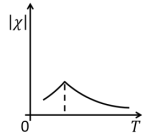
(P) Diamagnetic 2. 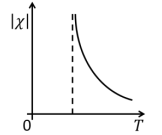
(Q) Paramagnetic 3. 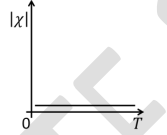
(R) Ferromagnetic 4. 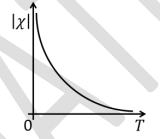
(S) Antiferromagnetic


