
The temperature $T$ dependence of magnetic susceptibility $\chi$ (Column I) of certain magnetic materials (Column II) are given below. Which of the following option is/are correct? Column IColumn II 1. 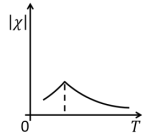
(P) Diamagnetic 2. 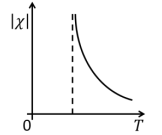
(Q) Paramagnetic 3. 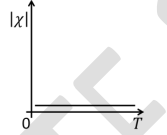
(R) Ferromagnetic 4. 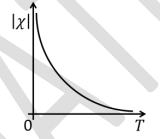
(S) Antiferromagnetic
To solve the question, we need to match the temperature dependence graphs of magnetic susceptibility \(\chi\) given in Column I with the appropriate magnetic material types from Column II.
Diagrams Analysis:
| 1. | Looks like a constant value with respect to temperature (typical for diamagnetic materials). | |
| 2. | Shows decrease in susceptibility with increase in temperature, after a certain point typical of ferromagnetic behavior above Curie temperature. | |
| 3. | Decreases with increasing temperature, like typical antiferromagnetic materials. | |
| 4. | Shows a steep increase and then gradual decrease which is characteristic of paramagnetic behavior as per Curie-Weiss Law. |
Matching with Options:
- Diagrams: 1 - P, 2 - R, 3 - S, 4 - Q
- Correct Option(s):
- 4 - Q, 2 - R, 1 - S
- 3 - P, 4 - Q, 2 - R
Conclusion: The correct matching of temperature-dependent magnetic susceptibility is:
- 4 - Q (Paramagnetic)
- 2 - R (Ferromagnetic)
- 1 - S (Antiferromagnetic)
- 3 - P (Diamagnetic)
The correct options that fit our analysis are:
4 - Q, 2 - R, 1 - S
3 - P, 4 - Q, 2 - R
Important Questions from Magnetostatics Ampere's Law Vector Potential
- Consider a particle of mass $m = 9.0 \times 10^{-5} \text{ kg}$ and charge $q = 3.0 \times 10^{-4} \text{ C}$ in a uniform electromagnetic field $\vec{E} = 2\hat{x} \text{ V.m}^{-1}$, $\vec{B} = 3\hat{z} \text{ V.m}^{-2}\text{.s}$. The particle is released from the coordinates $(0, 5\text{ m}, 0)$ at time $t = 0$. Starting from initial speed zero, it comes back to the $y$-axis for the first time at time $t$. The value of $t$ in seconds (rounded off to two decimal places) is _____
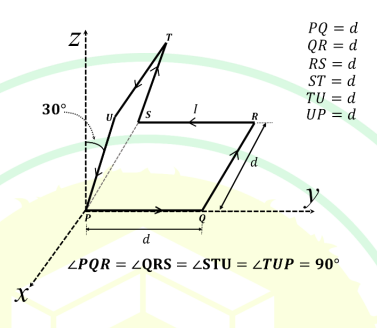
The wire loop shown in the figure carries a steady current $I$. Each straight section of the loop has length $d$. A part of the loop lies in xy plane and the other part is tilted at $30^\circ$ with respect to the xz plane. The magnitude of the magnetic dipole moment of the loop (in appropriate units) is
- A linear magnetic material in the form of a cylinder of radius $R$ and length $L$ is placed with its axis parallel to the $z$ axis. The cylinder has uniform magnetization $\vec{M} \hat{k}$. Which of the following option(s) is/are correct?
- Consider an isolated magnetized sphere of radius $R$ with a uniform magnetization $\vec{M}$ along the positive $z$ direction, with the north and south poles of the sphere lying on the $z$ axis. It is given that the magnetic field inside the sphere is $\vec{B} = \frac{2\mu_0}{3} \vec{M}$, where $\mu_0$ is the permeability of vacuum. Which of the following statements is(are) CORRECT?
An infinitely long cylinder of radius $R$ carries a frozen-in magnetization $\vec M = ke^{-s^2} \hat z$, where $k$ is a constant and $s$ is the distance from the axis of cylinder. The magnetic permeability of free space is $\mu_o$. There is no free current present anywhere. The magnetic flux density ($\vec B$) inside the cylinder is


