
Calculating Surface Energy Change of Breaking Droplet
The problem asks for the value of α representing the change in surface energy when a large liquid drop breaks into smaller droplets.
Initial Conditions
- Initial drop diameter, $d = 2\text{ mm}$.
- Initial drop radius, $R = d/2 = 1\text{ mm} = 1 \times 10^{-3}\text{ m}$.
- Number of smaller droplets, $N = 512$.
- Surface tension of the liquid, $T = 0.08\text{ N/m}$.
Step 1: Relate Radii using Volume Conservation
Assume the total volume of the liquid remains constant.
Volume of the large drop, $V_1 = \frac{4}{3}\pi R^3$.
Let the radius of each small droplet be $r$. The total volume of $N$ small droplets is $V_2 = N \times \frac{4}{3}\pi r^3$.
Equating volumes: $V_1 = V_2 \implies \frac{4}{3}\pi R^3 = N \times \frac{4}{3}\pi r^3$.
This simplifies to $R^3 = N r^3$, so $r = \frac{R}{N^{1/3}}$.
Since $N = 512 = 8^3$, we have $N^{1/3} = 8$. Therefore, $r = \frac{R}{8}$.
Step 2: Calculate Change in Surface Area
Initial surface area, $A_1 = 4\pi R^2$.
Final total surface area, $A_2 = N \times 4\pi r^2$. Substitute $r = R/N^{1/3}$:
$A_2 = N \times 4\pi \left(\frac{R}{N^{1/3}}\right)^2 = N \times 4\pi \frac{R^2}{N^{2/3}} = 4\pi R^2 N^{1/3}$.
The change in surface area is $\Delta A = A_2 - A_1$.
$\Delta A = 4\pi R^2 N^{1/3} - 4\pi R^2 = 4\pi R^2 (N^{1/3} - 1)$.
Substitute known values: $R = 10^{-3}\text{ m}$ and $N^{1/3} = 8$.
$\Delta A = 4\pi (10^{-3}\text{ m})^2 (8 - 1) = 4\pi \times 10^{-6} \times 7 = 28\pi \times 10^{-6}\text{ m}^2$.
Step 3: Calculate Change in Surface Energy
The change in surface energy is given by $\Delta E = T \times \Delta A$.
$\Delta E = (0.08\text{ N/m}) \times (28\pi \times 10^{-6}\text{ m}^2)$.
$\Delta E = (8 \times 10^{-2}) \times (28\pi \times 10^{-6}) = 224\pi \times 10^{-8}\text{ J}$.
$\Delta E = 2.24\pi \times 10^{-6}\text{ J}$.
Using the approximation $\pi \approx 3.14$:
$\Delta E \approx 2.24 \times 3.14 \times 10^{-6} \approx 7.0336 \times 10^{-6}\text{ J}$.
Step 4: Determine the Value of α
The problem states that the change in surface energy is $\alpha \times 10^{-6}\text{ J}$.
Comparing our calculated $\Delta E$ with the given expression: $\alpha \times 10^{-6}\text{ J} \approx 7.0336 \times 10^{-6}\text{ J}$.
Therefore, $\alpha \approx 7.0336$.
Rounding to the nearest integer, the value of $\alpha$ is 7.
Similar Questions
A wire of length 10 cm and diameter 0.5 mm is used in a bulb. The temperature of the wire is 1727°C and power radiated by the wire is 94.2 W. Its emissivity is $\frac{x}{8}$ where x =……
(Given $\sigma = 6.0 \times 10^{-8}$ W m$^{-2}$ K$^{-4}$, $\pi = 3.14$ and assume that the emissivity of wire material is same at all wavelength.)
A water drop of radius $1$ cm is broken into eight equal droplets. Surface tension of water is $0.075$ N $m^{-1}$. The gain in surface energy is __________$\times10^{-7}$ J.(Take $\pi = 3.14$)
- Two water drops of radius 'r' each coalesce to form a single large drop. If 'T' is the surface tension, then the surface energy released in this process is:
A gas is kept in a container having walls which are thermally non-conducting. Initially the gas has a volume of $800 \ cm^3$ and temperature $27^{\circ}C$. The change in temperature when the gas is adiabatically compressed to $200 \ cm^3$ is:
(Take $\gamma = 1.5$; $\gamma$ is the ratio of specific heats at constant pressure and at constant volume)
- Match List - I with List - II.Choose the correct answer from the options given below :
List - I List - II (A) Heat capacity of body (I) $J kg^{-1}$ (B) Specific heat capacity of body (II) $J K^{-1}$ (C) Latent heat (III) $J kg^{-1} K^{-1}$ (D) Thermal conductivity (IV) $J m^{-1} K^{-1} s^{-1}$ - The surface tension of a soap solution is $3.5 \times 10^{-2}~\text{N/m}$. The work required to increase the radius of a soap bubble from $1~\text{cm}$ to $2~\text{cm}$ is $\alpha \times 10^{-6}~\text{J}$. The value of $\alpha$ is________.
($\pi = 22/7$) - The surface tension of a soap bubble is $0.03\text{ N/m}$. The work done in increasing the diameter of bubble from $2\text{ cm}$ to $6\text{ cm}$ is $\alpha\pi \times 10^{-4}\text{ J}$. The value of $\alpha$ is __________. (Take $\pi = 3.14$)
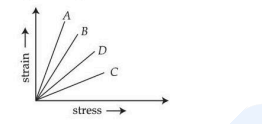
The strain-stress plot for materials $A, B, C$ and $D$ is shown in the figure. Which material has the largest Young's modulus ?
- Given below are two statements:
Statement I: Pressure of a fluid is exerted only on a solid surface in contact as the fluid-pressure does not exist everywhere in a still fluid.
Statement II: Excess potential energy of the molecules on the surface of a liquid, when compared to interior, results in surface tension.
In the light of the above statements, choose the correct answer from the options given below - Consider a rectangular sheet of solid material of length 1 m and width 4 cm. The coefficient of linear expansion is $\alpha=3.1\times10^{-5}K^{-1}$ at room temperature and one atmospheric pressure. The mass of sheet $m=0.1$ kg and the specific heat capacity $C_v=900 J kg^{-1}K^{-1}$. If the amount of heat supplied to the material is $8.1 \times 10^2 J$ then change in area of the rectangular sheet is :
Important Questions from Physical and Thermal Properties of Bulk Matter
A wire of length 10 cm and diameter 0.5 mm is used in a bulb. The temperature of the wire is 1727°C and power radiated by the wire is 94.2 W. Its emissivity is $\frac{x}{8}$ where x =……
(Given $\sigma = 6.0 \times 10^{-8}$ W m$^{-2}$ K$^{-4}$, $\pi = 3.14$ and assume that the emissivity of wire material is same at all wavelength.)
A water drop of radius $1$ cm is broken into eight equal droplets. Surface tension of water is $0.075$ N $m^{-1}$. The gain in surface energy is __________$\times10^{-7}$ J.(Take $\pi = 3.14$)
- Two water drops of radius 'r' each coalesce to form a single large drop. If 'T' is the surface tension, then the surface energy released in this process is:
A gas is kept in a container having walls which are thermally non-conducting. Initially the gas has a volume of $800 \ cm^3$ and temperature $27^{\circ}C$. The change in temperature when the gas is adiabatically compressed to $200 \ cm^3$ is:
(Take $\gamma = 1.5$; $\gamma$ is the ratio of specific heats at constant pressure and at constant volume)
- Match List - I with List - II.Choose the correct answer from the options given below :
List - I List - II (A) Heat capacity of body (I) $J kg^{-1}$ (B) Specific heat capacity of body (II) $J K^{-1}$ (C) Latent heat (III) $J kg^{-1} K^{-1}$ (D) Thermal conductivity (IV) $J m^{-1} K^{-1} s^{-1}$


