
A light ray is falling on a face of an equilateral glass prism as shown in the figure :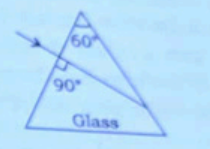
Which one of the following diagrams correctly shows the complete path of the ray through the glass prism?
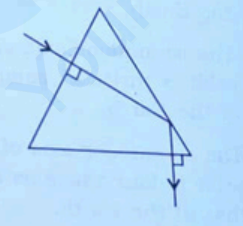
The question involves understanding the path of a light ray passing through an equilateral glass prism. Here, we need to determine which diagram accurately shows the light's path through the prism. Let's break down the process:
- The light ray enters the prism at a face, making an incident angle with the normal.
- Refraction occurs at the entrance because the speed of light changes as it moves from air (or vacuum) into glass, affecting the ray's direction according to Snell's Law: \(n_1 \sin \theta_1 = n_2 \sin \theta_2\), where \(n_1\) and \(n_2\) are the refractive indices of air and glass respectively, and \(\theta_1\) and \(\theta_2\) are the angles of incidence and refraction.
- After refraction through the first surface, the light travels across the prism and approaches the second face.
- At the second face, another refraction occurs as the light exits the prism back into the air. The light again changes direction according to Snell's Law.
- For an equilateral prism with equal angles, the ray inside typically bends towards the base of the prism and, upon exiting, bends away from the normal.
Given these steps, the correct diagram of the path will show the light ray bending towards the base inside the prism and bending away upon exiting. This process is accurately displayed in the third option.
Hence, the correct diagram illustrating the path of the light ray through the glass prism is the third option.
Important Questions from Refraction and Reflection
A convex lens of focal length f will form a magnified real image of an object, if the object is placed.
A ray of light travelling in the direction \(\frac{1}{2} (\hat i + \sqrt 3 \hat j)\) is incident on a plane mirror. After reflection it travels along the direction \(\frac{1}{2} (\hat i - \sqrt 3 \hat j)\) The angle of incidence is:
Twinkling of stars is due to atmospheric
An optical fibre has a core material of refractive index of 1.55 and cladding material of refractive index of 1.50. The numerical aperture of the fibre is
- The refracting angle of a prism is $A$. The refractive index of the material of the prism is $\frac{1+\cos A}{\sin A}$. The angle of minimum deviation is:



