
Understanding Laser Beam Diffraction
This problem involves understanding how a laser beam spreads out as it travels over a long distance due to diffraction. We are given the initial size of the laser beam, its wavelength, and the distance to the moon. We need to estimate the size of the beam when it returns to Earth after reflecting off the moon.
Laser Beam Parameters and Assumptions
The key information provided is:
- Initial beam diameter, $d_0$ = 1 cm = $0.01$ m
- Laser wavelength, $\lambda$ = 500 nm = $5 \times 10^{-7}$ m
- Distance to the Moon, $L$ = 384,000 km = $3.84 \times 10^8$ m
We assume the beam propagates through a vacuum and experiences ideal diffraction-limited spreading. This means the spreading is solely due to the wave nature of light and is not worsened by atmospheric effects or imperfections.
Physics of Beam Spreading
Laser beams, especially over long distances, tend to spread out. For lasers, this spreading is often modeled using the principles of Gaussian beams. The beam radius (distance from the center to the point where intensity drops to $1/e^2$ of the maximum) at a distance $z$ from the beam waist is given by:
$w(z) = w_0 \sqrt{1 + \left(\frac{z}{z_R}\right)^2}$
where:
- $w_0$ is the initial beam radius (waist size) at $z=0$.
- $z_R = \frac{\pi w_0^2}{\lambda}$ is the Rayleigh range, a characteristic distance over which the beam radius grows significantly.
In this problem, the initial beam diameter $d_0 = 1$ cm, so the initial radius is $w_0 = d_0/2 = 0.005$ m.
Calculating the Rayleigh Range
First, let's calculate the Rayleigh range ($z_R$) for this laser beam:
$z_R = \frac{\pi w_0^2}{\lambda} = \frac{\pi (0.005 \text{ m})^2}{5 \times 10^{-7} \text{ m}}$
$z_R = \frac{\pi \times 2.5 \times 10^{-5} \text{ m}^2}{5 \times 10^{-7} \text{ m}} = \frac{\pi \times 2.5}{0.05} \text{ m} = 50\pi \text{ m} \approx 157 \text{ m}$
Beam Spreading in the Far-Field
The distance to the moon ($L \approx 3.84 \times 10^8$ m) is vastly larger than the Rayleigh range ($z_R \approx 157$ m). This means the beam is propagating deep into the far-field region ($z \gg z_R$). In this far-field region, the Gaussian beam formula simplifies significantly. The term $(z/z_R)^2$ becomes much larger than 1, so:
$w(L) \approx w_0 \sqrt{\left(\frac{L}{z_R}\right)^2} = w_0 \frac{L}{z_R}$
Substituting the expression for $z_R$ back into this equation:
$w(L) \approx w_0 \frac{L}{(\pi w_0^2 / \lambda)} = \frac{\lambda L}{\pi w_0}$
This formula shows that in the far-field, the beam radius grows linearly with distance $L$. The diameter $D(L)$ is twice the radius, $D(L) = 2w(L)$.
$D(L) \approx \frac{2 \lambda L}{\pi w_0}$
Since $w_0 = d_0/2$, we can also write this in terms of the initial diameter $d_0$:
$D(L) \approx \frac{2 \lambda L}{\pi (d_0/2)} = \frac{4 \lambda L}{\pi d_0}$
Estimating the Final Beam Diameter
Now, let's plug in the values to calculate the estimated diameter $D(L)$ upon returning to Earth:
- $\lambda = 5 \times 10^{-7}$ m
- $L = 3.84 \times 10^8$ m
- $d_0 = 0.01$ m
Using the formula $D(L) \approx \frac{4 \lambda L}{\pi d_0}$:
$D(L) \approx \frac{4 \times (5 \times 10^{-7} \text{ m}) \times (3.84 \times 10^8 \text{ m})}{\pi \times (0.01 \text{ m})}$
$D(L) \approx \frac{(20 \times 10^{-7}) \times (3.84 \times 10^8)}{\pi \times 10^{-2}} \text{ m}$
$D(L) \approx \frac{7.68 \times 10^2 \text{ m}^2}{\pi \times 10^{-2} \text{ m}} = \frac{768}{\pi \times 0.01} \text{ m}$
$D(L) \approx \frac{768}{0.0314159} \text{ m} \approx 24446 \text{ m}$
Final Diameter in Kilometers
Converting the result to kilometers:
$D(L) \approx 24446 \text{ m} \times \frac{1 \text{ km}}{1000 \text{ m}} \approx 24.45 \text{ km}$
Conclusion on Beam Diameter Estimate
The calculated diameter of the laser beam upon returning to Earth is approximately $24.45$ km. Comparing this value to the options provided:
- 200 m
- 20 m
- 20 km
- 200 km
The value $24.45$ km is closest to the option 20 km. Therefore, 20 km is the best estimate for the beam diameter.
Important Questions from Optics and Diffraction
Three identical pinholes separated by distance $a$ along the x-axis are illuminated by a collimated monochromatic coherent beam of light (wavelength $\lambda$) as shown in the figure below.
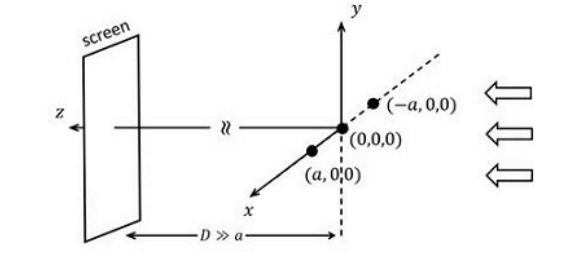
The intensity (in arbitrary units) pattern of fringes obtained on a screen kept at distance $D$ ($D>>a$) along the z- axis is best represented by
Two coherent plane electromagnetic waves of wavelength $0.5 \ \mu\text{m}$ (both have the same amplitude and are linearly polarized along the $z$-direction) fall on the $y = 0$ plane. Their wave vectors $\mathbf{k}_1$ and $\mathbf{k}_2$ are as shown in the figure.
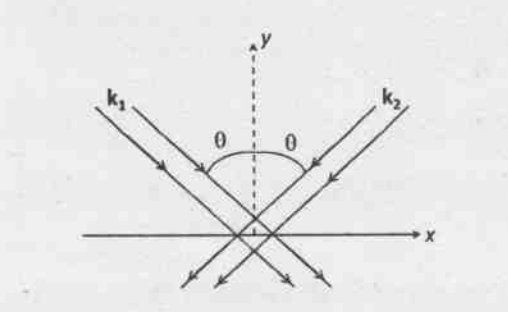
If the angle $\theta$ is $30^\circ$, the fringe spacing of the interference pattern produced on the plane is
The figure below describes the arrangement of slits and screens in a Young's double slit experiment. The width of the slit in $\text{S}_1$ is $a$ and the slits in $\text{S}_2$ are of negligible width.
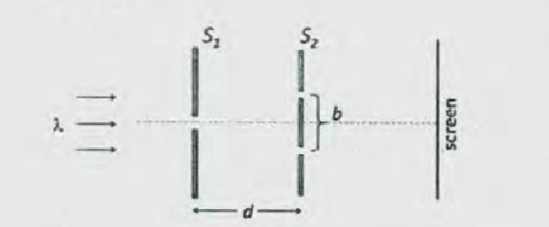
If the wavelength of the light is $\lambda$, the value of $d$ for which the screen would be dark is- The separation between the energy levels of a two-level atom is 2 eV. Suppose that $4 \times 10^{20}$ atoms are in the ground state and $7 \times 10^{20}$ atoms are pumped into the excited state just before lasing starts. How much energy will be released in a single laser pulse?
A screen has two slits, each of width $w$, with their centres at a distance $2w$ apart. It is illuminated by a monochromatic plane wave travelling along the $x$-axis.
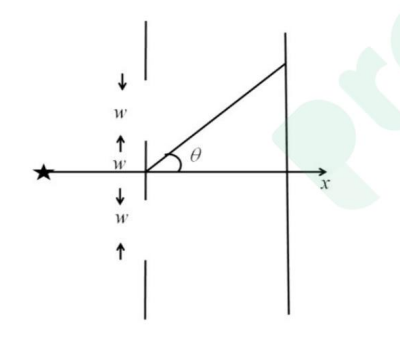
The intensity of the interference pattern, measured on a distant screen, at an angle $\theta = n\lambda/w$ to the $x$-axis is


