
Semiconductor Resistivity Calculation
The problem asks for the resistivity ($\rho$) of a Germanium (Ge) semiconductor doped with an acceptor impurity.
Given Parameters
- Dopant Type: Acceptor (making it a p-type semiconductor)
- Acceptor Concentration ($N_A$): $1 \times 10^{15}$ atoms/cm$^3$
- Hole Mobility ($\mu_p$): $1800 \text{ cm}^2/\text{V-s}$
- Elementary Charge ($q$): $1.6 \times 10^{-19} \text{ C}$
Resistivity Formula
For a p-type semiconductor, the majority charge carriers are holes. The concentration of holes ($p$) is approximately equal to the acceptor concentration ($N_A$), i.e., $p \approx N_A$. The electrical conductivity ($\sigma$) is given by:
$ \sigma = q p \mu_p $
Resistivity ($\rho$) is the reciprocal of conductivity:
$ \rho = \frac{1}{\sigma} = \frac{1}{q p \mu_p} $
Since $p \approx N_A$, the formula becomes:
$ \rho = \frac{1}{q N_A \mu_p} $
Calculation
Substitute the given values into the resistivity formula:
$ \rho = \frac{1}{(1.6 \times 10^{-19} \text{ C}) \times (1 \times 10^{15} \text{ cm}^{-3}) \times (1800 \text{ cm}^2/\text{V-s})} $
First, calculate the denominator:
$ q N_A \mu_p = (1.6 \times 10^{-19}) \times (1 \times 10^{15}) \times 1800 $
$ q N_A \mu_p = (1.6 \times 1800) \times 10^{-19+15} $
$ q N_A \mu_p = 2880 \times 10^{-4} \text{ S/cm} $
$ q N_A \mu_p = 0.2880 \text{ S/cm} $
Now, calculate the resistivity:
$ \rho = \frac{1}{0.2880 \text{ S/cm}} $
$ \rho \approx 3.4722 \text{ } \Omega \text{ cm} $
Conclusion
The calculated resistivity is approximately $3.472 \text{ } \Omega \text{ cm}$, which matches Option C.
Important Questions from Band Theory Effective Mass Holes
- For the energy dispersion of an electron in a one-dimensional solid $E(k) = E_0 - 2\gamma \cos(ka)$, the ratio of the effective mass of the electron in the solid to the free electron mass ($m_e$) at $k = 0$ is $R_0$. Taking $\gamma = 0.5 \text{ eV}$ and $a = 0.5 \text{ nm}$, the value of $R_0$ (rounded off to two decimal place) is _____
($\hbar = 1.054 \times 10^{-34} \text{ J.s}$, $m_e = 9.1 \times 10^{-31} \text{ kg}$, electron charge $= 1.6 \times 10^{-19} \text{ C}$) The dispersion ($E(k)$) of the conduction band (CB) and valence band (VB) for a semiconductor are shown schematically in the figure. Considering the possibility of an electron making a transition from the bottom of the CB to the top of the VB, which of the following options is/are correct?
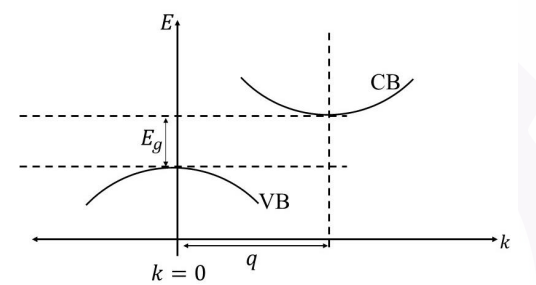
For nonrelativistic electrons in a solid, different energy dispersion relations (with effective masses $m_a^*$, $m_b^*$, and $m_c^*$) are schematically shown in the plots. Which one of the following options is CORRECT?
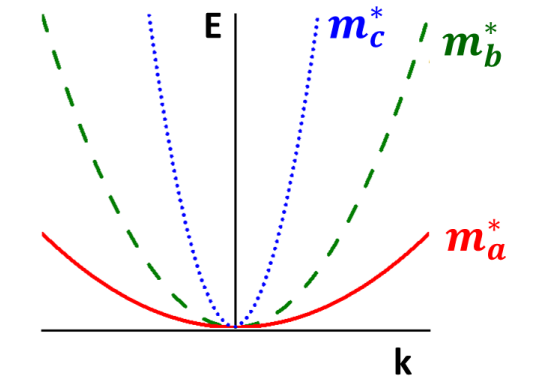
The temperature dependence of the electrical conductivity ($\sigma$) of three intrinsic semiconductors A, B and C is shown in figure.
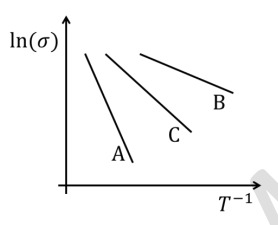
Let $E_A$, $E_B$ and $E_C$ be the bandgaps of A, B and C, respectively. Which one of the following relations is correct?- The energy dispersion for electrons in one dimensional lattice with lattice parameter $a$ is given by $E(k) = E_0 - \frac{1}{2} W \cos ka$, where $W$ and $E_0$ are constants. The effective mass of the electron near the bottom of the band is


