
Distance Calculation for Cyclist Motion
This question requires us to calculate the total distance covered by a cyclist. We are provided with the cyclist's speed and the duration of their travel. To find the distance, we will use the basic formula relating distance, speed, and time.
Understanding the Given Information
The problem provides us with two key pieces of information:
- The speed at which the cyclist travels is $18\ km/hr$.
- The time the cyclist travels for is $2.5\ hours$.
The Fundamental Formula
In physics, the relationship between distance, speed, and time is defined by the formula:
$ \text{Distance} = \text{Speed} \times \text{Time} $
This formula states that the distance traveled by an object is equal to its speed multiplied by the time it spends traveling.
Step-by-Step Calculation
To find the distance the cyclist covers, we need to plug the given values into the formula:
$ \text{Distance} = 18\ km/hr \times 2.5\ hours $
Now, let's perform the multiplication:
$ 18 \times 2.5 $
We can calculate this as follows:
$ 18 \times 2.5 = 18 \times \frac{5}{2} $
$ = \frac{18}{2} \times 5 $
$ = 9 \times 5 $
$ = 45 $
So, the distance covered by the cyclist is $45\ km$.
Conclusion on Distance Covered
Based on the calculation using the speed and time provided, the cyclist covers a distance of $45\ km$.
Important Questions from Speed Time & Distance (Notes)
- Ajay walks at a speed of 4 km/hr. He doubles his speed after reaching exactly half way. He walks for 12 hours in all. What is the total distance travelled by him ?
With a certain set of diameters, a tractor's front wheels make 2 revolutions (revs) for every 1 revolution of the rear wheels. The effect of changing wheel diameter(s) is shown in the following plot.
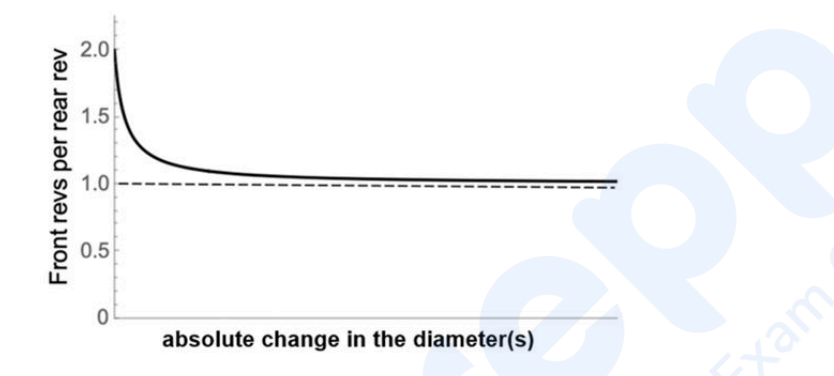
In this context, which of the following statements is CORRECT?- A train travels from Karnal to Kurukshetra at a speed of $90$ km/hr and returns at a speed of $92$ km/hr. If it takes $182$ hours for total travel, then find the distance between Karnal to Kurukshetra. (In Km)
A car covers 4 successive stretches of 3 km each at speed of 10 kmph, 20 kmph, 30 kmph and 60 kmph respectively. The average speed of the car for the entire journey is:
- A cyclist travels at 18 km/hr for 2.5 hours. What distance does he cover?


