
Superconductor Critical Field Calculation
The relationship between the critical magnetic field ($H_c$) and temperature ($T$) for a type-I superconductor can be approximated by the empirical formula:
$H_c(T) = H_c(0) \left[ 1 - \left( \frac{T}{T_c} \right)^2 \right]$
Where:
- $H_c(T)$ is the critical magnetic field at temperature $T$.
- $H_c(0)$ is the critical magnetic field at 0 K.
- $T_c$ is the critical temperature at zero magnetic field.
- $T$ is the temperature of interest.
Applying the Formula
Given values:
- $T_c = 4.7$ K
- $H_c(0) = 0.3$ T
- $T = 2$ K
Substitute the values into the formula:
- Calculate the temperature ratio squared: $ \left( \frac{T}{T_c} \right)^2 = \left( \frac{2 \text{ K}}{4.7 \text{ K}} \right)^2 \approx (0.4255)^2 \approx 0.1811 $
- Calculate the term in the brackets: $ 1 - \left( \frac{T}{T_c} \right)^2 \approx 1 - 0.1811 = 0.8189 $
- Calculate the critical field at 2 K: $ H_c(2 \text{ K}) = H_c(0) \times [1 - (T/T_c)^2] \approx 0.3 \text{ T} \times 0.8189 \approx 0.24567 \text{ T} $
- Round the result to three decimal places: $ H_c(2 \text{ K}) \approx 0.246 \text{ T} $
The calculated critical magnetic field at 2 K is approximately 0.246 T, which falls within the expected range of 0.244 T to 0.248 T.
Important Questions from Superconductivity Meissner Effect BCS Theory
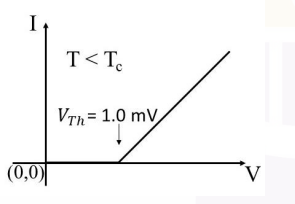
Consider a metal-superconductor junction connected to a dc voltage $V$. At $T < T_c$, where $T_c$ is the superconductor's transition temperature, the current $I$ versus $V$ behavior of this junction is shown schematically in the figure below. If the superconducting energy gap is $D \text{ meV}$. The value of $D$ (rounded off to one decimal place) is _____
- Which of the following option(s) is/are correct for a Type I superconductor?
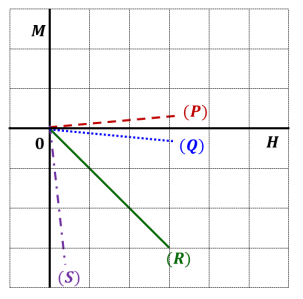
The figure schematically shows the $M$ (magnetization) - $H$ (magnetic field) plots for certain types of materials. Here $M$ and $H$ are plotted in the same scale and units. Which one of the following is the most appropriate combination?
- A material behaves as a superconductor below a critical temperature $T_c$ and as a normal conductor above $T_c$. A magnetic field $\vec{B} = B\hat{z}$ is applied when $T > T_c$. The material is then cooled below $T_c$ in the presence of $\vec{B}$. Which of the following figure represent the correct configuration of magnetic field lines?
- Amongst electrical resistivity ($\rho$), thermal conductivity ($\kappa$), specific heat ($C$), Young's modulus ($Y$), and magnetic susceptibility ($\chi$), which quantities show a sharp change at the superconducting transition temperature?


