
Probability Problem Analysis
This problem involves calculating the probability of a specific event occurring when multiple independent events happen simultaneously. We need to determine the likelihood that at least two out of three individuals (A, B, and C) successfully hit the target with their single shots.
Defining Individual Probabilities
First, let's determine the probability of each person hitting the target and the probability of them missing the target. We assume each shot is an independent event.
-
Person A: Hits 3 out of 5 shots.
Probability of A hitting, $P(A) = \frac{3}{5}$
Probability of A missing, $P(A') = 1 - P(A) = 1 - \frac{3}{5} = \frac{2}{5}$
-
Person B: Hits 2 out of 5 shots.
Probability of B hitting, $P(B) = \frac{2}{5}$
Probability of B missing, $P(B') = 1 - P(B) = 1 - \frac{2}{5} = \frac{3}{5}$
-
Person C: Hits 3 out of 4 shots.
Probability of C hitting, $P(C) = \frac{3}{4}$
Probability of C missing, $P(C') = 1 - P(C) = 1 - \frac{3}{4} = \frac{1}{4}$
Calculating Probability of 'At Least Two Shots Hit'
The event 'at least two shots hit' includes the following mutually exclusive scenarios:
- Exactly two shots hit the target.
- Exactly three shots hit the target.
We will calculate the probability of each scenario and then sum them up.
Scenario 1: Exactly Two Shots Hit
This scenario can occur in three distinct ways, based on who misses the target:
- A hits, B hits, C misses: The probability is $P(A \cap B \cap C') = P(A) \times P(B) \times P(C')$
- A hits, B misses, C hits: The probability is $P(A \cap B' \cap C) = P(A) \times P(B') \times P(C)$
- A misses, B hits, C hits: The probability is $P(A' \cap B \cap C) = P(A') \times P(B) \times P(C)$
Let's calculate the probability for each specific combination:
- Probability (A hits, B hits, C misses) = $\frac{3}{5} \times \frac{2}{5} \times \frac{1}{4} = \frac{6}{100}$
- Probability (A hits, B misses, C hits) = $\frac{3}{5} \times \frac{3}{5} \times \frac{3}{4} = \frac{27}{100}$
- Probability (A misses, B hits, C hits) = $\frac{2}{5} \times \frac{2}{5} \times \frac{3}{4} = \frac{12}{100}$
The total probability of exactly two shots hitting is the sum of these probabilities:
P(Exactly 2 hits) = $\frac{6}{100} + \frac{27}{100} + \frac{12}{100} = \frac{45}{100}$
Scenario 2: Exactly Three Shots Hit
This occurs only when all three individuals, A, B, and C, hit the target simultaneously:
$P(A \cap B \cap C) = P(A) \times P(B) \times P(C)$
$P(A \cap B \cap C) = \frac{3}{5} \times \frac{2}{5} \times \frac{3}{4} = \frac{18}{100}$
So, the probability of exactly three shots hitting is P(Exactly 3 hits) = $\frac{18}{100}$
Total Probability Calculation
To find the overall probability that at least two shots hit the target, we add the probabilities calculated for the two scenarios (exactly 2 hits and exactly 3 hits):
P(At least 2 hits) = P(Exactly 2 hits) + P(Exactly 3 hits)
P(At least 2 hits) = $\frac{45}{100} + \frac{18}{100}$
P(At least 2 hits) = $\frac{63}{100}$
Final Answer
The calculated probability that at least two shots hit the target is $\frac{63}{100}$.
Important Questions from Probability (Notes)
- A stick of length L is broken into two pieces at random. What is the average length of the smaller piece?
- Two students are solving the same problem independently. If the probability that the first one solves the problem is $\frac{3}{5}$ and the probability that the second solves the problem is $\frac{4}{5}$, what is the probability that at least one of them solves the problem?
- A fair die was thrown three times and the outcome was repeatedly six. If the die is thrown again what is the probability of getting six?
- 12 balls, 3 each of the colours red, green, blue and yellow are put in a box and mixed. If 3 balls are picked at random, without replacement, the probability that all 3 balls are of the same colour is
A canal system is shown in the figure.
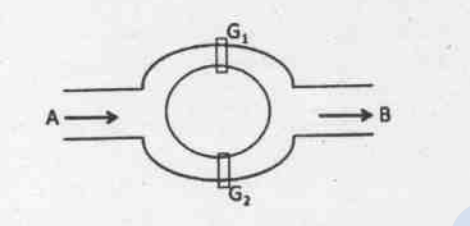
Water flows from A to B through two channels. Gates $G_1$ and $G_2$ are operated independently to regulate the flow. Probability of $G_1$ to be open is 10% while that of $G_2$ is 20%. The probability that water will flow from A to B is


