
CAT 2025 Question Paper with Answer Key, Download PDF
CAT 2025 was conducted by IIM Calcutta on November 30, 2025, in a computer-based format across three slots. The exam tested candidates on Verbal Ability & Reading Comprehension (VARC), Data Interpretation & Logical Reasoning (DILR), and Quantitative Aptitude (QA). CAT 2025 scores are accepted by all 20 IIMs and over 1,200 MBA institutes across India.
CAT 2025 Question Paper and Answer Key PDF

CAT 2025 reflects the current exam trend where accuracy, smart selection, and balanced section performance matter more than high attempt volume.
CAT 2025 Slot 1 Question Paper and Answer Key PDFs

CAT 2025 Slot 2 Question Paper and Answer Key PDFs
CAT 2025 Slot 3 Question Paper and Answer Key PDFs
CAT 2025 Shift Timings
CAT 2025 was conducted in 3 slots on a single day. Each slot had a fixed reporting time and a 2-hour exam window.
| Slot | Exam Date | Duration | Timing |
|---|---|---|---|
| Slot 1 (Morning) | November 30, 2025 | 2 Hours | 8:30 AM – 10:30 AM |
| Slot 2 (Afternoon) | November 30, 2025 | 2 Hours | 12:30 PM – 2:30 PM |
| Slot 3 (Evening) | November 30, 2025 | 2 Hours | 4:30 PM – 6:30 PM |
CAT 2025 Exam Pattern
CAT 2025 focused on speed, reasoning accuracy, and reading comprehension depth. The three-section in CAT exam pattern and marking scheme with structure remained similar to previous years, with TITA (non-MCQ) questions present across all sections.
| Particulars | Details |
|---|---|
| Exam Mode | CBT mode |
| Question Type | MCQ + TITA (Type In The Answer) |
| Duration | 120 Minutes (40 Minutes per Section) |
| Total Questions | 66 |
| Total Marks | 198 |
| Negative Marking | -1 for wrong MCQ answers; No negative for TITA |
CAT 2025 Subject-wise Distribution
CAT 2025 exam structure includes three primary sections: Quantitative Aptitude, Verbal Ability & Reading Comprehension and Data Interpretation & Logical Reasoning. CAT 2025 Subject-wise Distribution In detail is listed in the table below:
| Section | Questions | Marks | Duration |
|---|---|---|---|
| Verbal Ability & Reading Comprehension (VARC) | 24 | 72 | 40 Minutes |
| Data Interpretation & Logical Reasoning (DILR) | 20 | 60 | 40 Minutes |
| Quantitative Aptitude (QA) | 22 | 66 | 40 Minutes |
| Total | 66 | 198 | 120 Minutes |
Note: VARC carries the highest weightage and is typically the most decisive section for top percentile achievers.
CAT 2025 Paper Analysis
CAT 2025 paper analysis varied across all three slots. In terms of overall difficulty, the paper was moderate to tough, with DILR being the most unpredictable section this year. Slot-wise difficulty was not entirely uniform.
| Section | Paper Analysis |
|---|---|
| VARC | RC-heavy; 4 passages with 16 questions; VA had sentence rearrangement and odd sentence out; reading depth was key |
| DILR | Toughest section this year: 4 sets each in DI and LR; 2 sets were very time-consuming and required careful selection strategy |
| QA | Moderate; Arithmetic and Algebra dominated; number theory and geometry appeared; TITA questions were calculation-heavy |
CAT 2025 Stream-wise Analysis & Difficulty Level
CAT 2025 was conducted for MBA admissions, and difficulty varied slot-wise, with DILR being the most challenging across all three windows.
CAT 2025 Slot 1 (Morning)
CAT 2025 Slot 1 was relatively balanced and aligned with a moderate difficulty level across sections. Candidates found the paper stable, with no extreme surprises in question patterns.
| Section | Difficulty | Key Observation |
|---|---|---|
| VARC | Moderate | RC + sentence placement, balanced structure |
| DILR | Moderate | LR-heavy sets, predictable structure |
| QA | Moderate–Difficult | Arithmetic + Algebra, slightly calculation-heavy |
CAT 2025 Slot 2 (Afternoon)
CAT 2025 Slot 2 introduced slightly higher execution pressure, especially in DILR and QA. The paper required a more careful selection of questions to maintain accuracy.
| Section | Difficulty | Key Observation |
|---|---|---|
| VARC | Moderate | RC + inference-based questions, close options |
| DILR | Moderate | Mixed logical sets, selection mattered |
| QA | Moderate–Difficult | Geometry + equations, time-consuming |
CAT 2025 Slot 3 (Evening)
CAT 2025 Slot 3 was comparatively more time-intensive, especially in DILR, where sets demanded higher logical depth. QA also required longer calculation steps.
| Section | Difficulty | Key Observation |
|---|---|---|
| VARC | Moderate | RC-heavy, stable difficulty |
| DILR | Difficult | Multi-variable sets, toughest section |
| QA | Difficult | Multi-step calculations, reduced attempts |
CAT 2025 Important Topics & Weightage
CAT 2025 questions were largely concept-heavy and application-driven. The table below reflects the expected distribution of high-yield topics across all three sections.
| Section | Expected Weightage | Important Topics |
|---|---|---|
| VARC | 24 Questions | Reading Comprehension (inference, tone, structure), Para-jumbles, Para-summary, Odd Sentence Out |
| DILR | 20 Questions | Arrangements, Grouping, Games & Tournaments, Bar Graphs, Tables, Caselets, Network Diagrams |
| QA | 22 Questions | Arithmetic (percentages, profit-loss, TSD, work), Algebra, Number System, Geometry, Progressions, Probability |
CAT 2025 Most Repeated Topics: Section-Wise
After reviewing CAT 2025 papers across all three slots, clear patterns emerge in question frequency. Preparing these high-repeat topics will give aspirants the highest return on study time.
| Section | Most Repeated Topics |
|---|---|
| VARC | RC Inference Questions, Paragraph Summary, Sentence Rearrangement (TITA), Odd Sentence Out |
| DILR | Seating Arrangement, Game Theory Sets, Bar/Line Chart Combinations, Binary Logic, Team Selection |
| QA | Time-Speed-Distance, Profit & Loss, Quadratic Equations, Geometry (Circles & Triangles), Number System (Remainders), Permutation & Combination |
Candidates can also check CAT Syllabus: Check Section-Wise Curriculum & Mock Tests.
CAT 2025 Good Attempts
CAT good attempts vary by slot and individual accuracy. Because of the -1 negative marking on MCQs, accuracy matters more than attempt count. The table below shows safe attempt ranges for each section.
| Section | Safe Attempts | Competitive Attempts | 99 Percentile Zone |
|---|---|---|---|
| VARC | 14–17 | 18–20 | 20+ |
| DILR | 10–12 | 13–16 | 16+ |
| QA | 12–15 | 16–18 | 18+ |
| Overall | 38–44 | 45–52 | 52+ |
Note: These are indicative ranges. Final percentile also depends on overall test-taker performance and IIM Calcutta's normalisation formula.
CAT 2025 Cut-offs & Top Participating Institutes
CAT 2025 cut-offs vary based on overall percentile, sectional percentile requirements, category, and institute preference. Top IIMs like IIM Ahmedabad, IIM Bangalore, and IIM Calcutta typically close at 99+ overall percentile with high sectional scores.
| Percentile Range | Expected Colleges |
|---|---|
| 99.5+ Percentile | IIM Ahmedabad, IIM Bangalore, IIM Calcutta (ABC calls) |
| 99–99.5 Percentile | IIM Lucknow, IIM Kozhikode, IIM Indore |
| 97–99 Percentile | IIM Shillong, IIM Udaipur, IIM Trichy, IIM Rohtak, newer IIMs |
| 95–97 Percentile | MDI Gurgaon, NITIE (now NIT), SPJIMR, SIBM Pune, IIFT |
| 90–95 Percentile | NMIMS, TAPMI, Great Lakes, IMT Ghaziabad, IMI Delhi |
| Below 90 Percentile | Limited options in preferred MBA specialisations |
CAT 2025 Selection Process
CAT 2025 selection is not based solely on the percentile score. Each IIM and participating institute has its own shortlisting criteria which typically includes academic profile, work experience, gender diversity, and Written Ability Test (WAT) + Personal Interview (PI) performance. Steps in the CAT 2025 selection process are summarised below:
- CAT 2025 result and percentile declaration
- Shortlisting by individual IIMs and B-schools based on composite score
- WAT-PI calls and Written Ability Test / Essay Writing rounds
- Personal Interview (PI) at respective campuses or online, Final merit list preparation considering CAT score + academics + PI performance
- Seat acceptance and fee payment to confirm admission
Also Read: CAT Eligibility Criteria is an important checkpoint before registration for MBA aspirants.
CAT 2025 Topper Approach
CAT 2025 toppers Vinayak Agarwal who crossed 99.9 percentile emphasised a preparation style built on mock test discipline, section-wise accuracy targets, and smart question selection during the exam. Their consistent approach to high-difficulty sets and time-bound practice defined their edge over others.
CAT 2025 Toppers’ Tips & Preparation Strategy
- Solved 50+ full-length mock tests under timed conditions; analysed every mock thoroughly
- Prioritised Reading Comprehension heavily: read 2–3 long-form articles daily for 6 months
- Used a strict set-selection strategy in DILR, skipped difficult sets in the first 5 minutes rather than wasting time
- Revised formula sheets for QA daily in the final 3 months
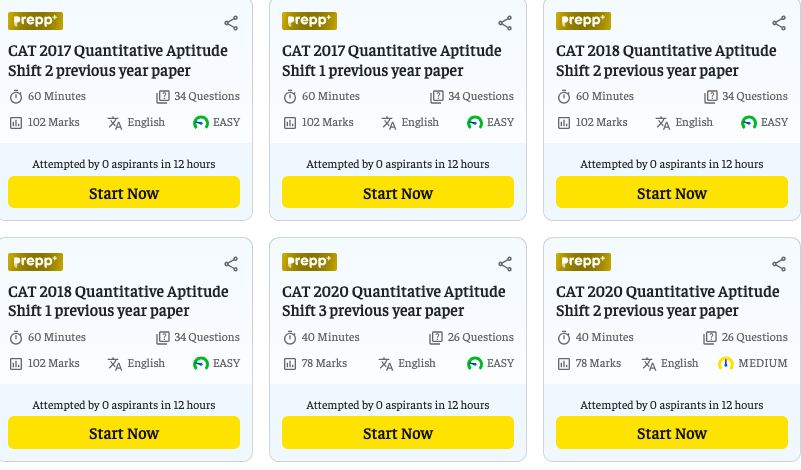
- Targeted 90%+ accuracy over maximising total attempts with practice of CAT Previous year question paper and
IIM Admission Process & Choice Filling Strategy
IIM Admission Process (commonly referred to as CAP or the post-CAT selection process) refers to the method students use while shortlisting and applying to institutes after CAT result declaration. The order and combination of colleges and courses you target directly affect your interview call chances, upgrade options, and final admission outcome. A smart post-CAT strategy helps students:
- Maximise interview call chances across multiple IIMs and top B-schools
- Avoid targeting only reach schools without safeties
- Get better college or programme upgrades in subsequent rounds
- Secure backup options across non-IIM top institutes
- Improve branch and specialisation combinations based on profile fit
CAT result is followed by shortlisting, WAT-PI rounds, and final merit list preparation. Admission is then granted into MBA, MBA (Finance), MBA (Agri-Business), and allied courses across IIMs and participating institutes. Final seat confirmation depends on WAT-PI performance, category, and institute-specific weightage on academic and work-experience profiles.
CAT 2025 FAQs
Ques: How does IIM Calcutta resolve ties if two candidates score the same percentile?
Ans: IIM Calcutta uses a composite score formula that factors in academic performance (10th and 12th marks), graduation score, gender diversity, and work experience to break percentile ties during shortlisting.
Ques: Is there a sectional cut-off required to qualify for IIM calls in CAT 2025?
Ans: Yes. Almost all IIMs have minimum sectional percentile requirements in addition to the overall percentile cut-off. Candidates must clear both the overall and section-wise thresholds to receive interview calls.
Ques: Can candidates freely switch between sections during the 2-hour CAT 2025 exam?
Ans: No. CAT 2025 has a strict sectional time limit of 40 minutes per section. Candidates cannot move to another section before the allotted time for the current section expires.
Ques: How does IIM Calcutta normalise scores across three slots to calculate the percentile?
Ans: IIM Calcutta uses an equi-percentile normalisation method to account for variation in difficulty across slots, ensuring a fair comparison of raw scores before the final percentile is computed.
Ques: I appeared in both CAT 2024 and CAT 2025. Which score will be considered for admissions?
Ans: Each IIM uses only the most recent valid CAT score for shortlisting. Your CAT 2025 score will be considered for the 2025 admission cycle, and it does not carry forward to future cycles.
Download the PREPP App and attempt FREE CAT Mock Tests and get complete study material!


Comments