
XPQY is a vertical smooth long loop having a total resistance $R$ where PX is parallel to QY and separation between them is $l$. A constant magnetic field $B$ perpendicular to the plane of the loop exists in the entire space. A rod CD of length $L \ (L > l)$ and mass $m$ is made to slide down from rest under the gravity as shown in figure. The terminal speed acquired by the rod is _________ m/s. (g = acceleration due to gravity)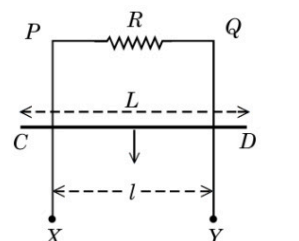
To determine the terminal speed acquired by the rod, we need to analyze the forces acting on the rod when it reaches terminal velocity. The rod CD slides down under gravity and moves through a magnetic field, inducing an electromotive force (emf) and thus a current.
- As the rod moves with velocity \(v\) through the magnetic field \(B\), an emf is induced across the length \(l\) of the loop given by Faraday's law: \(E = B \cdot l \cdot v\).
- This emf causes a current \(I\) to flow in the loop: \(I = \frac{E}{R} = \frac{B \cdot l \cdot v}{R}\).
- The magnetic force \(F_m\) opposing the motion of the rod is given by: \(F_m = B \cdot I \cdot l = B \cdot \left(\frac{B \cdot l \cdot v}{R}\right) \cdot l = \frac{B^2 \cdot l^2 \cdot v}{R}\).
- At terminal velocity, the magnetic force balances the gravitational force, hence: \(m \cdot g = \frac{B^2 \cdot l^2 \cdot v}{R}\).
- Solving for terminal velocity \(v\): \(v = \frac{m \cdot g \cdot R}{B^2 \cdot l^2}\).
Thus, the terminal speed acquired by the rod is \(\frac{mgR}{B^2l^2}\) m/s.
This matches the given correct answer. Understanding the balance of forces is key to solving this kind of problem.
Similar Questions
- The electric current in the circuit is given as $i = i_o(t/T)$. The r.m.s current for the period $t = 0$ to $t = T$ is ________.
- In the potentiometer, when the cell in the secondary circuit is shunted with $4\text{ }\Omega$ resistance, the balance is obtained at the length $120\text{ cm}$ of wire. Now when the same cell is shunted with $12\text{ }\Omega$ resistance, the balance is shifted to a length of $180\text{ cm}$. The internal resistance of cell is ________$\Omega$
- The electric field of an electromagnetic wave travelling through a medium is given by $\vec{E}(x,t) = 25 \sin(2.0 \times 10^{15} t - 10^7 x) \hat{n}$
then the refractive index of the medium is ________.
(All given measurement are in SI units) Three long straight wires carrying current are arranged mutually parallel as shown in the figure. The force experienced by $15 \text{ cm}$ length of wire $Q$ is________.
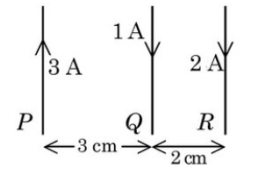
$(\mu_o = 4\pi \times 10^{-7} \text{ T.m/A})$- For the two cells having same EMF $E$ and internal resistance $r$, the current passing through the external resistor $6\text{ }\Omega$ is same when both the cells are connected either in parallel or in series. The value of internal resistance $r$ is ________$\Omega$.
- The magnetic field at the centre of a current carrying circular loop of radius $R$ is $16 \text{ \mu T}$. The magnetic field at a distance $x = \sqrt{3}R$ on its axis from the centre is ________$\text{\mu T}$.
- Two point charges of $1 \text{ nC}$ and $2 \text{ nC}$ are placed at the two corners of equilateral triangle of side $3 \text{ cm}$. The work done in bringing a charge of $3 \text{ nC}$ from infinity to the third corner of the triangle is ________$\text{\mu J}$.
$\frac{1}{4\pi\epsilon_0} = 9 \times 10^9 \text{ N.m}^2\text{/C}^2$ The equivalent resistance between the points $A$ and $B$ in the following circuit is $\frac{x}{5} \text{ }\Omega$. The value of $x$ is ________.
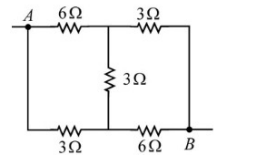
- Three identical coils $C_1, C_2$ and $C_3$ are closely placed such that they share a common axis. $C_2$ is exactly midway. $C_1$ carries current $I$ in anti-clockwise direction while $C_3$ carries current $I$ in clockwise direction. An induced current flows through $C_2$ will be in clockwise direction when
A meter bridge with two resistances $R_1$ and $R_2$ as shown in figure was balanced (null point) at 40 cm from the point $P$. The null point changed to 50 cm from the point $P$, when $16 \ \Omega$ resistance is connected in parallel to $R_2$. The values of resistances $R_1$ and $R_2$ are _________.
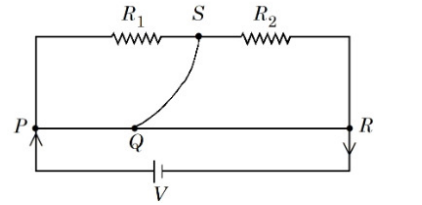
Important Questions from Electricity and Magnetism
- The electric current in the circuit is given as $i = i_o(t/T)$. The r.m.s current for the period $t = 0$ to $t = T$ is ________.
- In the potentiometer, when the cell in the secondary circuit is shunted with $4\text{ }\Omega$ resistance, the balance is obtained at the length $120\text{ cm}$ of wire. Now when the same cell is shunted with $12\text{ }\Omega$ resistance, the balance is shifted to a length of $180\text{ cm}$. The internal resistance of cell is ________$\Omega$
- The electric field of an electromagnetic wave travelling through a medium is given by $\vec{E}(x,t) = 25 \sin(2.0 \times 10^{15} t - 10^7 x) \hat{n}$
then the refractive index of the medium is ________.
(All given measurement are in SI units) Three long straight wires carrying current are arranged mutually parallel as shown in the figure. The force experienced by $15 \text{ cm}$ length of wire $Q$ is________.
$(\mu_o = 4\pi \times 10^{-7} \text{ T.m/A})$- For the two cells having same EMF $E$ and internal resistance $r$, the current passing through the external resistor $6\text{ }\Omega$ is same when both the cells are connected either in parallel or in series. The value of internal resistance $r$ is ________$\Omega$.


