
Given : Molar mass of HCl and $\text{Ba(OH)}_2$ are 36.5 and $171.0\text{ g mol}^{-1}$ respectively.
Titration Calculation: Mass of HCl
This solution explains how to determine the mass of pure HCl ($x$ mg) used in an aqueous solution based on its titration with barium hydroxide ($Ba(OH)_2$). We use the principles of stoichiometry and molarity calculations.
Step 1: Write the Balanced Chemical Equation
The reaction between hydrochloric acid (HCl) and barium hydroxide ($Ba(OH)_2$) is a neutralization reaction. The balanced equation is:
$ 2 \text{HCl}(aq) + \text{Ba(OH)}_2(aq) \rightarrow \text{BaCl}_2(aq) + 2 \text{H}_2\text{O}(l) $
This equation shows that 2 moles of HCl react completely with 1 mole of $Ba(OH)_2$.
Step 2: Calculate Moles of $Ba(OH)_2$ Used
We are given:
- Volume of $Ba(OH)_2$ solution = 25.0 mL = $0.0250\text{ L}$
- Molarity of $Ba(OH)_2$ solution = $0.1\text{ M} = 0.1\text{ mol/L}$
The number of moles of $Ba(OH)_2$ is calculated as:
$ \text{Moles of Ba(OH)}_2 = \text{Molarity} \times \text{Volume (in L)} $
$ \text{Moles of Ba(OH)}_2 = 0.1\text{ mol/L} \times 0.0250\text{ L} = 0.0025\text{ mol} $
Step 3: Calculate Moles of HCl Reacted
Using the stoichiometry from the balanced equation (2 moles HCl : 1 mole $Ba(OH)_2$):
$ \text{Moles of HCl} = 2 \times \text{Moles of Ba(OH)}_2 $
$ \text{Moles of HCl} = 2 \times 0.0025\text{ mol} = 0.0050\text{ mol} $
Step 4: Calculate the Mass of HCl
We need the mass of HCl in milligrams ($x$ mg). First, calculate the mass in grams using the molar mass of HCl (36.5 g/mol):
$ \text{Mass of HCl (g)} = \text{Moles of HCl} \times \text{Molar mass of HCl} $
$ \text{Mass of HCl (g)} = 0.0050\text{ mol} \times 36.5\text{ g/mol} = 0.1825\text{ g} $
Now, convert the mass from grams to milligrams (1 g = 1000 mg):
$ \text{Mass of HCl (mg)} = 0.1825\text{ g} \times 1000\text{ mg/g} = 182.5\text{ mg} $
Step 5: Determine the Value of $x$
The question states that the mass of HCl is $x$ mg, and the answer should be in the format $x \times 10^{-1}$ mg, rounded to the nearest integer. We found the mass to be 182.5 mg.
$ 182.5\text{ mg} = x \times 10^{-1}\text{ mg} $
$ 182.5 = \frac{x}{10} $
$ x = 182.5 \times 10 $
$ x = 1825 $
Rounding to the nearest integer gives $x = 1825$.
Similar Questions
- Consider two Group IV metal ions $\text{X}^{2+}$ and $\text{Y}^{2+}$.
A solution containing 0.01 M $\text{X}^{2+}$ and 0.01 M $\text{Y}^{2+}$ is saturated with $\text{H}_2\text{S}$. The pH at which the metal sulphide YS will form as a precipitate is ______. (Nearest integer)
(Given: $\text{K}_{sp}(\text{XS}) = 1 \times 10^{-22}$ at $25^\circ\text{C}$, $\text{K}_{sp}(\text{YS}) = 4 \times 10^{-16}$ at $25^\circ\text{C}$, $[\text{H}_2\text{S}] = 0.1\text{M}$ in solution, $\text{K}_{a1} \times \text{K}_{a2}(\text{H}_2\text{S}) = 1.0 \times 10^{-21}$, $\log 2 = 0.30$, $\log 3 = 0.48$, $\log 5 = 0.70$) - The half-life of ${}^{65}\text{Zn}$ is 245 days. After x days, 75% of original activity remained. The value of $x$ in days is _______. (Nearest integer)
(Given: $\log 3 = 0.4771$ and $\log 2 = 0.3010$) - Molar conductivity of a weak acid HQ of concentration $0.18 \text{ M}$ was found to be $1/30$ of the molar conductivity of another weak acid HZ with concentration of $0.02 \text{ M}$. If $\lambda^\circ_{Q^-}$ happened to be equal with $\lambda^\circ_{Z^-}$, then the difference of the $\text{pK}_a$ values of the two weak acids ($\text{pK}_a\text{(HQ)} - \text{pK}_a\text{(HZ)}$) is _______ (Nearest integer).
[Given: degree of dissociation ($\alpha$) < < 1 for both weak acids, $\lambda^\circ$ : limiting molar conductivity of ions] - The first and second ionization constants of $\text{H}_2\text{X}$ are $2.5 \times 10^{-8}$ and $1.0 \times 10^{-13}$ respectively. The concentration of $\text{X}^{2-}$ in $0.1\text{ M}$ $\text{H}_2\text{X}$ solution is __________ $\times 10^{-15}\text{ M}$. (Nearest Integer)
- The osmotic pressure of a living cell is $12\text{ atm}$ at $300\text{ K}$. The strength of sodium chloride solution that is isotonic with the living cell at this temperature is __________ $\text{g L}^{-1}$. (Nearest integer)
Given : $\text{R} = 0.08\text{ L atm K}^{-1}\text{ mol}^{-1}$
Assume complete dissociation of $\text{NaCl}$
(Given : Molar mass of $\text{Na}$ and $\text{Cl}$ are $23$ and $35.5\text{ g mol}^{-1}$ respectively.) - $MX$ is a sparingly soluble salt that follows the given solubility equilibrium at $298\text{ K}$.
$\text{MX (s)} \rightleftharpoons \text{M}^+\text{ (aq)} + \text{X}^-\text{ (aq)}; \quad \text{K}_{\text{sp}} = 10^{-10}$
If the standard reduction potential for $\text{M}^+\text{(aq)} \xrightarrow{+\text{e}^-} \text{M(s)}$ is $\left(\text{E}^\ominus_{\text{M}^+/\text{M}}\right) = 0.79\text{ V}$, then the value of the standard reduction potential for the metal/metal insoluble salt electrode $\text{E}^\ominus_{\text{X}^-/\text{MX (s)}/\text{M}}$ is __________ $\text{mV}$. (nearest integer)
[Given : $\frac{2.303\text{ RT}}{\text{F}} = 0.059\text{ V}$] - $\text{A} \longrightarrow \text{B} \text{ (first reaction)}$
$\text{C} \longrightarrow \text{D} \text{ (second reaction)}$
Consider the above two first-order reactions. The rate constant for first reaction at $500\text{ K}$ is double of the same at $300\text{ K}$. At $500\text{ K}$, $50\%$ of the reaction becomes complete in $2\text{ hour}$. The activation energy of the second reaction is half of that of first reaction. If the rate constant at $500\text{ K}$ of the second reaction becomes double of the rate constant of first reaction at the same temperature; then rate constant for the second reaction at $300\text{ K}$ is _________ $\times 10^{-1}\text{hour}^{-1}$ (nearest integer). For the thermal decomposition of reactant $\text{AB(g)}$, the following plot is constructed.
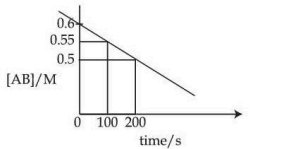
The half life of the reaction is '$x$' min.
$x = $ ___________ min. (Nearest integer)
- For the following gas phase equilibrium reaction at constant temperature,
$\text{NH}_3\text{(g)} \rightleftharpoons \frac{1}{2}\text{N}_2\text{(g)} + \frac{3}{2}\text{H}_2\text{(g)}$
if the total pressure is $\sqrt{3}\text{ atm}$ and the pressure equilibrium constant ($\text{K}_p$) is $9\text{ atm}$, then the degree of dissociation is given as $(x \times 10^{-2})^{-1/2}$. The value of $x$ is ___________. (nearest integer) - $200 \text{ cc}$ of $x \times 10^{-3} \text{ M}$ potassium dichromate is required to oxidise $750 \text{ cc}$ of $0.6 \text{ M}$ Mohr's salt solution in acidic medium.
Here $x =$ ________.
Important Questions from Physical Chemistry
- Consider two Group IV metal ions $\text{X}^{2+}$ and $\text{Y}^{2+}$.
A solution containing 0.01 M $\text{X}^{2+}$ and 0.01 M $\text{Y}^{2+}$ is saturated with $\text{H}_2\text{S}$. The pH at which the metal sulphide YS will form as a precipitate is ______. (Nearest integer)
(Given: $\text{K}_{sp}(\text{XS}) = 1 \times 10^{-22}$ at $25^\circ\text{C}$, $\text{K}_{sp}(\text{YS}) = 4 \times 10^{-16}$ at $25^\circ\text{C}$, $[\text{H}_2\text{S}] = 0.1\text{M}$ in solution, $\text{K}_{a1} \times \text{K}_{a2}(\text{H}_2\text{S}) = 1.0 \times 10^{-21}$, $\log 2 = 0.30$, $\log 3 = 0.48$, $\log 5 = 0.70$) - The half-life of ${}^{65}\text{Zn}$ is 245 days. After x days, 75% of original activity remained. The value of $x$ in days is _______. (Nearest integer)
(Given: $\log 3 = 0.4771$ and $\log 2 = 0.3010$) - Molar conductivity of a weak acid HQ of concentration $0.18 \text{ M}$ was found to be $1/30$ of the molar conductivity of another weak acid HZ with concentration of $0.02 \text{ M}$. If $\lambda^\circ_{Q^-}$ happened to be equal with $\lambda^\circ_{Z^-}$, then the difference of the $\text{pK}_a$ values of the two weak acids ($\text{pK}_a\text{(HQ)} - \text{pK}_a\text{(HZ)}$) is _______ (Nearest integer).
[Given: degree of dissociation ($\alpha$) < < 1 for both weak acids, $\lambda^\circ$ : limiting molar conductivity of ions] - The first and second ionization constants of $\text{H}_2\text{X}$ are $2.5 \times 10^{-8}$ and $1.0 \times 10^{-13}$ respectively. The concentration of $\text{X}^{2-}$ in $0.1\text{ M}$ $\text{H}_2\text{X}$ solution is __________ $\times 10^{-15}\text{ M}$. (Nearest Integer)
- The osmotic pressure of a living cell is $12\text{ atm}$ at $300\text{ K}$. The strength of sodium chloride solution that is isotonic with the living cell at this temperature is __________ $\text{g L}^{-1}$. (Nearest integer)
Given : $\text{R} = 0.08\text{ L atm K}^{-1}\text{ mol}^{-1}$
Assume complete dissociation of $\text{NaCl}$
(Given : Molar mass of $\text{Na}$ and $\text{Cl}$ are $23$ and $35.5\text{ g mol}^{-1}$ respectively.)


