
Hydraulic Machines: Why Liquids are Preferred Fluid Choice
Hydraulic machines, like hydraulic jacks or brakes, work by transmitting force through a fluid. The choice of fluid is crucial for the efficient operation of these systems. We typically use liquids, not gases, in hydraulic systems because of their distinct physical properties related to compressibility and pressure transmission.
Understanding Fluid Properties
The fundamental principle behind hydraulic machines is the transmission of pressure. According to Pascal's principle, pressure applied to an enclosed fluid is transmitted undiminished to every portion of the fluid and the walls of the containing vessel. For this principle to work effectively, the fluid must behave in a specific way when pressure is applied.
Liquids vs. Gases in Hydraulics
- Liquids: Liquids are considered nearly incompressible. This means that their volume does not significantly decrease when pressure is applied. When you push on a liquid in a confined space, it efficiently transmits that push (pressure) throughout the fluid.
- Gases: Gases, on the other hand, are highly compressible. When pressure is applied to a gas, its volume decreases significantly. If a gas were used in a hydraulic system, applying pressure would primarily compress the gas rather than transmit the force effectively to move a load or operate a mechanism. A significant amount of energy would be lost in compressing the gas itself.
Analyzing the Options
Let's look at why the correct option accurately describes the preference for liquids:
- Option 1: Liquids are compressible while gases are not. This statement is incorrect. Liquids are nearly incompressible, and gases are compressible.
- Option 2: Liquids are nearly incompressible and transfer the pressure applied to them. This statement correctly identifies the two key properties: liquids resist significant volume change (nearly incompressible) and efficiently transmit applied pressure. This allows hydraulic systems to function by transferring mechanical work.
- Option 3: Liquids are nearly incompressible and do not transfer the pressure applied to them. This statement is incorrect because liquids are excellent at transferring pressure.
- Option 4: Liquids are compressible and transfer the pressure applied to them. This statement is incorrect because liquids are nearly incompressible, not compressible in the way gases are.
Conclusion
Therefore, the reason we prefer liquids in hydraulic machines is their near incompressibility, which allows them to effectively transmit pressure ($P$) and force, enabling the machine to perform work. Gases' high compressibility would make them unsuitable for this purpose as they would absorb the applied pressure instead of transmitting it efficiently.
Important Questions from Miscellaneous
- An electromagnetic wave with its magnetic field $B = 0.3\cos(ky-10^8t)i$ tesla is propagating in a non-magnetic dielectric medium of refractive index 2. The wavelength of the wave is
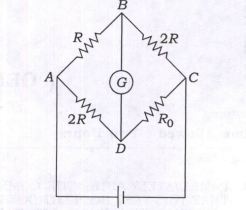
For a given system of resistors having resistances R, 2R, R$_0$ and 2R (shown in the figure), what will be the value of resistance of the resistor R$_0$, when there is NO current in the galvanometer G?
- A cyclotron has an oscillator frequency of $12\times10^6$ Hz and 'Dee' radius of 21 inches. The value of magnetic induction (field) needed to accelerate a deuteron (mass = $3.34 \times 10^{-27}$ kg and charge = $1.6\times10^{-19}$ C) is
- When white light propagating in air passes through a glass prism, it splits into a band of colours referred to as the white light spectrum. This phenomenon is called the dispersion of light. Among the following colours, the angle of deviation will be the highest in
- A threshold frequency for photoelectric emission in copper is $1.1\times10^{15}$ Hz. When the light of frequency $1.2\times10^{15}$ Hz is directed on the copper surface, the maximum energy of emitted particles would be (Planck's constant is $6.62\times10^{-34}$ J-s and the charge on the electron is $1.6\times10^{-19}$ C)


