
For a given system of resistors having resistances R, 2R, R$_0$ and 2R (shown in the figure), what will be the value of resistance of the resistor R$_0$, when there is NO current in the galvanometer G?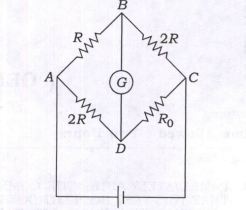
R$_0$ = 4R
To solve this problem, we need to determine the value of resistance \(R_0\) such that there is no current in the galvanometer \(G\). This condition implies a balanced Wheatstone bridge in the circuit.
In a Wheatstone bridge, the bridge is balanced, and no current flows through the galvanometer when:
| \(\frac{R_1}{R_2} = \frac{R_3}{R_4}\) |
Where \(R_1\) and \(R_2\) are the resistances in one branch and \(R_3\) and \(R_4\) in the opposite branch.
In this circuit (refer to the image), the resistances are arranged as follows:
- \(R_1 = R\) (AB)
- \(R_2 = 2R\) (BC)
- \(R_3 = 2R\) (AD)
- \(R_4 = R_0\) (DC)
Apply the balanced condition of the Wheatstone bridge:
| \(\frac{R}{2R} = \frac{2R}{R_0}\) |
This simplifies to:
| \(\frac{1}{2} = \frac{2R}{R_0}\) |
Cross-multiplying gives:
| \(R_0 = 2 \times 2R\) |
Therefore, \(R_0 = 4R\).
This confirms that the correct answer is \(R_0 = 4R\), leading to a balanced bridge and no current through the galvanometer.
Important Questions from Miscellaneous
- Which one of the following statements regarding hydrogen atom and other one electron species is correct?
- The correct order of penetrating ability of atomic orbitals is :
- The correct electronic configuration of Platinum is :
- The element with the highest enthalpy of atomization in the first transition series is :
- An element forms an ion in the +IV oxidation state with electronic configuration : $4d^4 \ 5d^{10}$. Which group and period of the Modern Periodic Table does the element belong to?


