
Understanding the Photoelectric Effect Calculation
This question asks us to determine the maximum kinetic energy ($KE_{max}$) of electrons emitted from a copper surface when exposed to light of a specific frequency. This scenario is governed by the principles of the photoelectric effect.
Key Concepts and Formula for Photoelectric Effect
The photoelectric effect describes the emission of electrons from a material upon the absorption of electromagnetic radiation, such as light. Key concepts include:
- Photon Energy ($E$): The energy carried by a single photon of light is calculated using the formula $E = hf$, where '$h$' is Planck's constant and '$f$' is the frequency of the light.
- Work Function ($\phi$): This is the minimum energy required to remove an electron from the surface of the metal. It is characteristic of the metal and is related to the threshold frequency ($f_0$) by the equation $\phi = hf_0$.
- Maximum Kinetic Energy ($KE_{max}$): When a photon's energy ($E$) is greater than the work function ($\phi$), the excess energy appears as the kinetic energy of the emitted electron. Einstein's photoelectric equation states: $$KE_{max} = E - \phi$$
By substituting the expressions for $E$ and $\phi$, we get:
$$KE_{max} = hf - hf_0$$
This can be simplified to:
$$KE_{max} = h(f - f_0)$$
Given Values
We are provided with the following information:
- Threshold frequency for copper ($f_0$): $1.1 \times 10^{15}$ Hz
- Frequency of the incident light ($f$): $1.2 \times 10^{15}$ Hz
- Planck's constant ($h$): $6.62 \times 10^{-34}$ J-s
- Charge of an electron ($e$): $1.6 \times 10^{-19}$ C (This is needed for converting the final energy from Joules to electron volts).
Step-by-Step Calculation
Step 1: Calculate the difference in frequencies
First, find the difference between the incident frequency ($f$) and the threshold frequency ($f_0$). This difference determines the portion of the photon's energy that contributes to the electron's kinetic energy.
$$ \Delta f = f - f_0 $$
$$ \Delta f = (1.2 \times 10^{15} \text{ Hz}) - (1.1 \times 10^{15} \text{ Hz}) $$
$$ \Delta f = 0.1 \times 10^{15} \text{ Hz} $$
Step 2: Calculate the maximum kinetic energy in Joules
Using the formula $KE_{max} = h \times \Delta f$, we can now calculate the kinetic energy in Joules.
$$ KE_{max} = (6.62 \times 10^{-34} \text{ J-s}) \times (0.1 \times 10^{15} \text{ Hz}) $$
$$ KE_{max} = 0.662 \times 10^{-34 + 15} \text{ J} $$
$$ KE_{max} = 0.662 \times 10^{-19} \text{ J} $$
Step 3: Convert kinetic energy from Joules to electron volts (eV)
The options are given in electron volts (eV). To convert the energy from Joules to eV, we use the conversion factor $1 \text{ eV} = 1.6 \times 10^{-19} \text{ J}$.
$$ KE_{max} (\text{eV}) = \frac{KE_{max} (\text{J})}{e} $$
$$ KE_{max} (\text{eV}) = \frac{0.662 \times 10^{-19} \text{ J}}{1.6 \times 10^{-19} \text{ J/eV}} $$
$$ KE_{max} (\text{eV}) = \frac{0.662}{1.6} $$
$$ KE_{max} (\text{eV}) \approx 0.41375 \text{ eV} $$
Final Answer Explanation
The calculated maximum kinetic energy is approximately 0.41375 eV. Rounding this to three decimal places gives 0.414 eV. Therefore, the maximum energy of the emitted particles is 0.414 eV.
Important Questions from Miscellaneous
- An electromagnetic wave with its magnetic field $B = 0.3\cos(ky-10^8t)i$ tesla is propagating in a non-magnetic dielectric medium of refractive index 2. The wavelength of the wave is
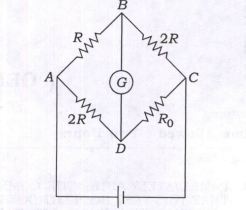
For a given system of resistors having resistances R, 2R, R$_0$ and 2R (shown in the figure), what will be the value of resistance of the resistor R$_0$, when there is NO current in the galvanometer G?
- A cyclotron has an oscillator frequency of $12\times10^6$ Hz and 'Dee' radius of 21 inches. The value of magnetic induction (field) needed to accelerate a deuteron (mass = $3.34 \times 10^{-27}$ kg and charge = $1.6\times10^{-19}$ C) is
- When white light propagating in air passes through a glass prism, it splits into a band of colours referred to as the white light spectrum. This phenomenon is called the dispersion of light. Among the following colours, the angle of deviation will be the highest in
- Why do we prefer to have a liquid and not a gas to be used as the fluid in a hydraulic machine?


