
Identifying the Incorrect Tree of Life Statement
The question asks to identify the INCORRECT statement regarding the evolutionary relatedness of various animal phyla as depicted in the tree of life. We need to evaluate each statement based on established phylogenetic classifications.
Analysis of Phylogenetic Relationships
- Statement 1 (Ctenophora vs. Cnidaria vs. Echinodermata): Ctenophora (comb jellies) and Cnidaria (jellyfish, corals) are often considered early branching Eumetazoa. Echinodermata (starfish) are Deuterostomes. Generally, Ctenophora and Cnidaria show closer affinities to each other than either does to Echinodermata. This statement is considered correct based on many phylogenetic models.
- Statement 2 (Porifera vs. Ctenophora vs. Echinodermata): Porifera (sponges) are typically placed as the most basal animal lineage. While the exact position of Ctenophora is debated (basal Eumetazoa or sister to other Eumetazoa), Porifera are more distantly related to a derived group like Echinodermata. This statement is considered correct.
- Statement 3 (Arthropoda vs. Tardigrada vs. Annelida): Arthropoda (insects, spiders) and Tardigrada (water bears) both belong to the Ecdysozoa clade (animals that molt). Annelida (worms) belong to the Lophotrochozoa clade. Therefore, Arthropoda are more closely related to Tardigrada than to Annelida. This statement is correct.
- Statement 4 (Arthropoda vs. Mollusca vs. Nematoda): This statement needs careful examination based on major clades within the Protostomes.
- Arthropoda belong to the Ecdysozoa clade.
- Nematoda also belong to the Ecdysozoa clade.
- Mollusca belong to the Lophotrochozoa clade.
Conclusion on Incorrect Statement
Based on the phylogenetic grouping of major animal phyla:
- Arthropoda and Nematoda are grouped together in Ecdysozoa.
- Mollusca are grouped in Lophotrochozoa.
Therefore, Arthropoda are more closely related to Nematoda than they are to Mollusca. Statement 4 asserts the opposite, making it the INCORRECT statement.
Important Questions from Phylogenetic trees
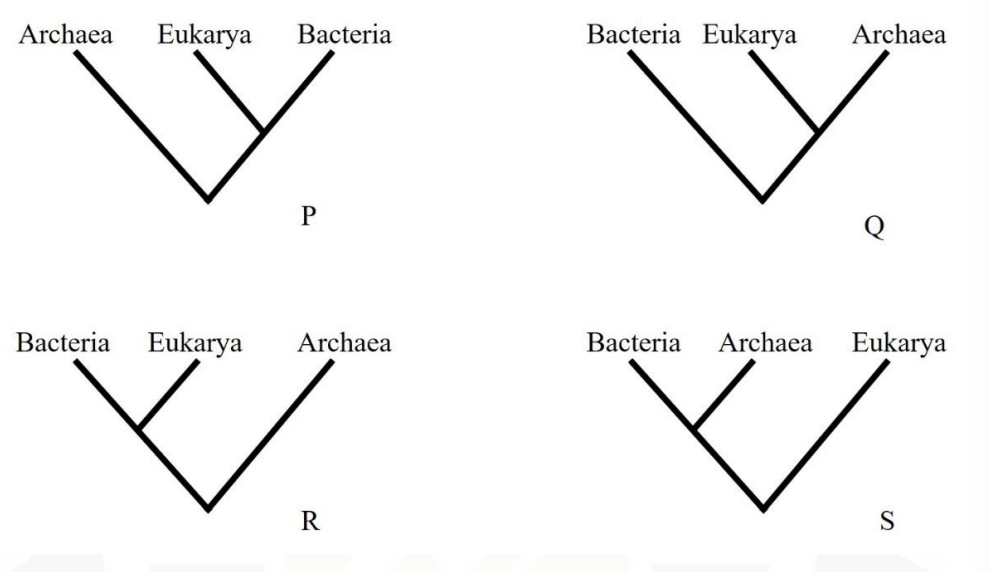
Which one of the following phylogenetic trees illustrates the relationship between Archaea, Bacteria and Eukarya?
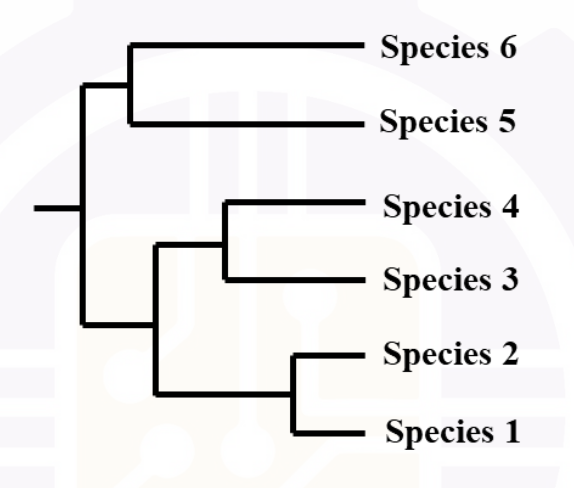
The phylogeny of six species of birds is illustrated below, where the horizontal branch lengths correspond to genetic distance. These six species are distributed in three islands X, Y, and Z. Island X harbours species 1, 4, 6; Island Y harbours species 1, 2, 4; and Island Z harbours species 3, 4, 5. Which one of the following is true about the phylogenetic diversity of these islands?
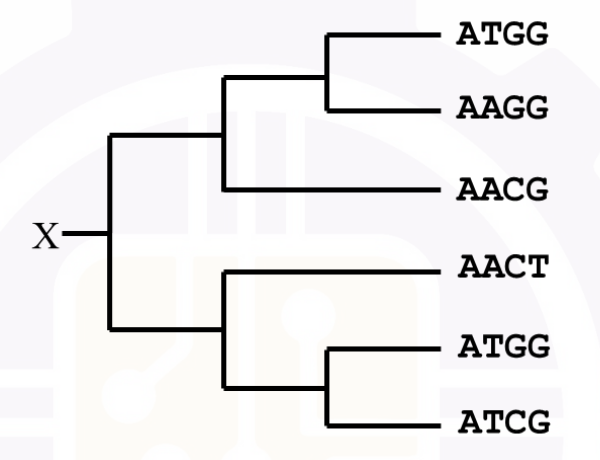
The phylogeny below shows the relationship between six species based on whole genome data. The sequence of a part of a particular gene from each species is provided at the tips of the tree. Based on the principle of parsimony, which one of the following is the expected sequence for the ancestor X?
A phylogenetic tree for the evolution of two pigmentation traits in species of fish is shown for clades X, Y and Z. Genes A and/or B, if mutated, can cause dark pigmentation in the body.
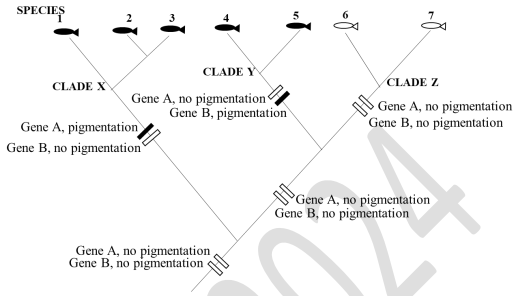
Which one or more of the following statements is/are correct?- Which of the following trees is phylogenetically MOST accurate?


