
The phylogeny of six species of birds is illustrated below, where the horizontal branch lengths correspond to genetic distance. These six species are distributed in three islands X, Y, and Z. Island X harbours species 1, 4, 6; Island Y harbours species 1, 2, 4; and Island Z harbours species 3, 4, 5. Which one of the following is true about the phylogenetic diversity of these islands?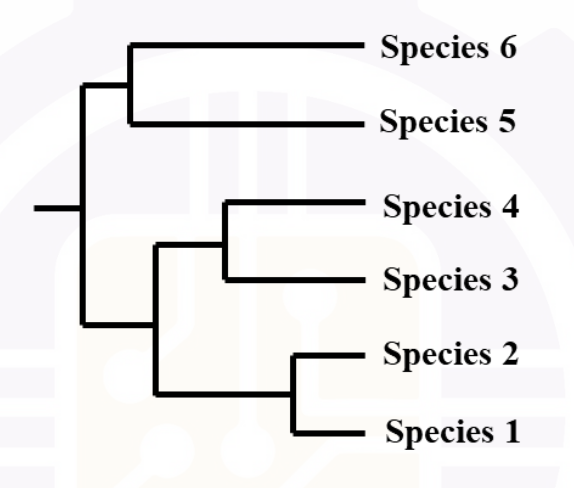
To determine the phylogenetic diversity of the islands, we need to understand how genetic distance impacts diversity. Phylogenetic diversity is a measure of biodiversity that takes into account the evolutionary relationships between species. It can be visualized by examining the branch lengths in the phylogenetic tree.
- Identify the species present on each island:
- Island X: Species 1, 4, 6
- Island Y: Species 1, 2, 4
- Island Z: Species 3, 4, 5
- Understand the phylogenetic tree: The horizontal branch lengths correspond to genetic distance. A greater length indicates a greater genetic diversity contribution.
- Calculate the total branch length for species on each island:
- Island X: With Species 1, 4, and 6. The presence of Species 6, which is distantly related, increases its diversity.
- Island Y: With Species 1, 2, and 4, the species are more closely related, resulting in lower diversity.
- Island Z: With Species 3, 4, and 5, the presence of distinct species increases diversity compared to Island Y.
- Compare the total phylogenetic diversity:
- Island X has the highest diversity due to the presence of species with more genetic distance.
- Island Z has more diversity than Island Y due to more genetically distant species.
Thus, comparing the phylogenetic diversity, we find the ranking as X > Y and Z > Y, confirming the correct answer.
Important Questions from Phylogenetic trees
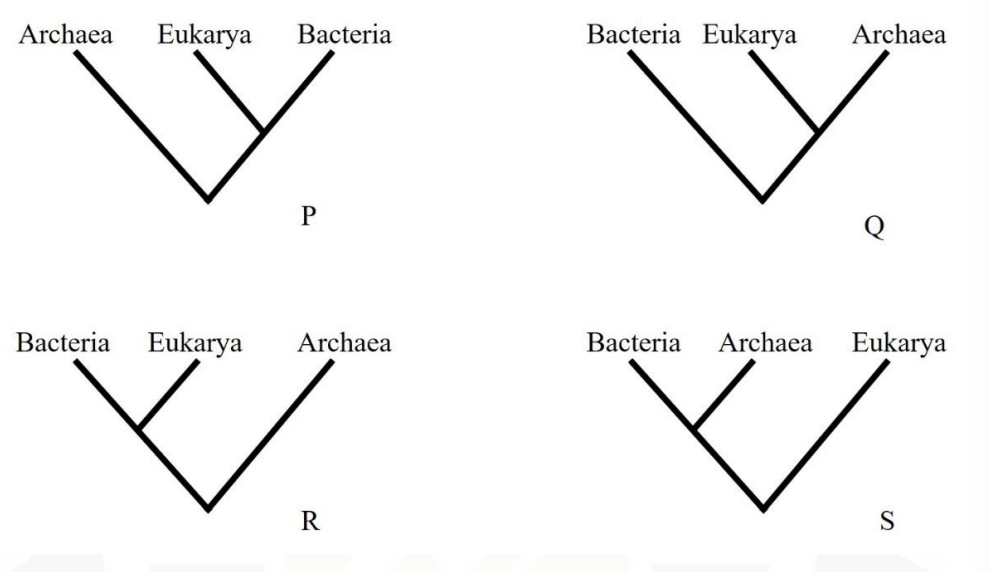
Which one of the following phylogenetic trees illustrates the relationship between Archaea, Bacteria and Eukarya?
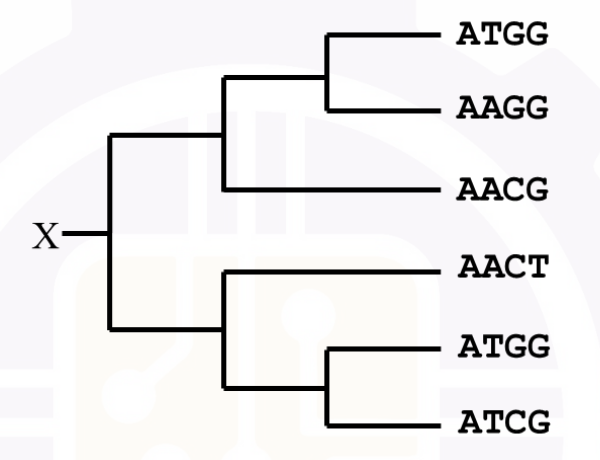
The phylogeny below shows the relationship between six species based on whole genome data. The sequence of a part of a particular gene from each species is provided at the tips of the tree. Based on the principle of parsimony, which one of the following is the expected sequence for the ancestor X?
A phylogenetic tree for the evolution of two pigmentation traits in species of fish is shown for clades X, Y and Z. Genes A and/or B, if mutated, can cause dark pigmentation in the body.
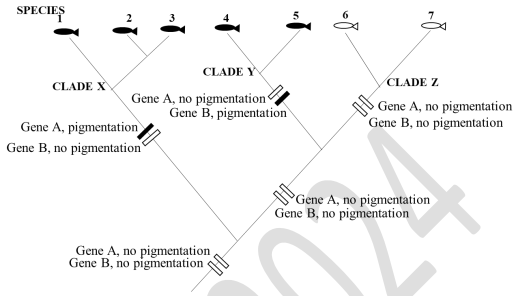
Which one or more of the following statements is/are correct?- Which of the following trees is phylogenetically MOST accurate?
- Whales and dolphins are hypothesized to have evolved along the northern shore of the Tethys Sea, prior to the Indian plate's collision with the Eurasian plate. To which one of the following animals are these aquatic mammals most closely related?


