
Evolutionary Relatives of Whales and Dolphins
Scientific studies, including fossil and molecular evidence, show that whales and dolphins (cetaceans) are closely related to even-toed ungulates (Artiodactyla). The closest living relatives identified are hippopotamuses, but among the given choices, pigs represent the closest evolutionary link.
- Pigs (Suina): Belong to the Artiodactyla order. Modern evidence strongly supports a close relationship between cetaceans and artiodactyls, with pigs being a related group within this larger classification.
- Elephants: Belong to the Afrotheria superorder, a different evolutionary branch.
- Seals: Belong to the Carnivora order (specifically Pinnipedia). Their lineage is distinct from cetaceans.
- Zebras: Belong to the Perissodactyla order (odd-toed ungulates), which is a different group from the Artiodactyla.
Therefore, pigs are considered the most closely related animals to whales and dolphins among the options provided.
The correct answer is pigs.
Important Questions from Phylogenetic trees
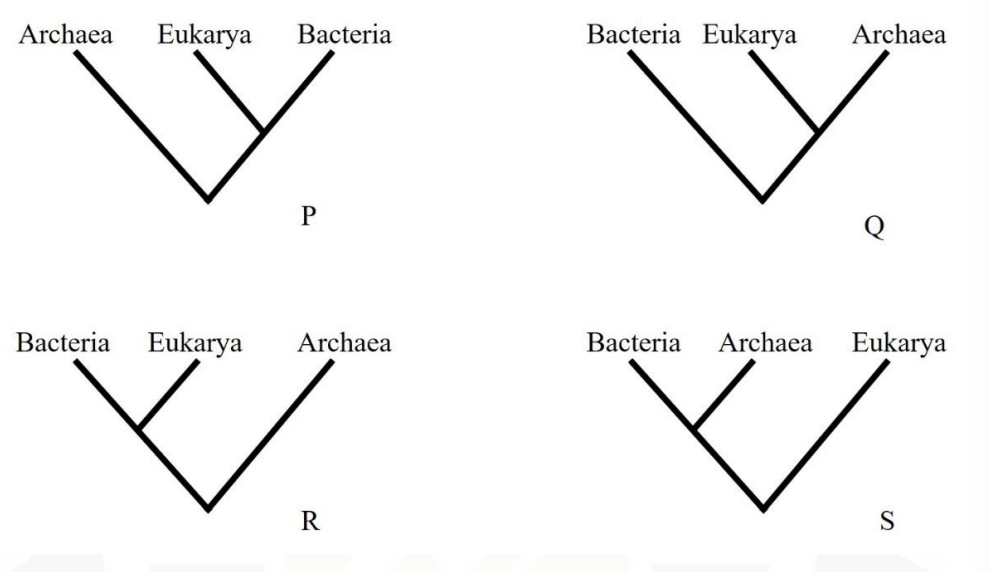
Which one of the following phylogenetic trees illustrates the relationship between Archaea, Bacteria and Eukarya?
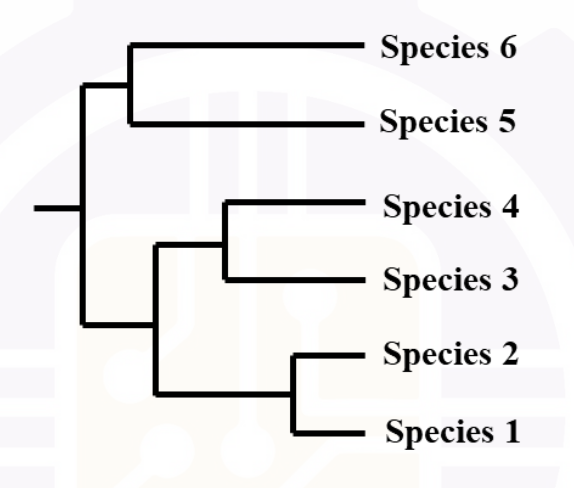
The phylogeny of six species of birds is illustrated below, where the horizontal branch lengths correspond to genetic distance. These six species are distributed in three islands X, Y, and Z. Island X harbours species 1, 4, 6; Island Y harbours species 1, 2, 4; and Island Z harbours species 3, 4, 5. Which one of the following is true about the phylogenetic diversity of these islands?
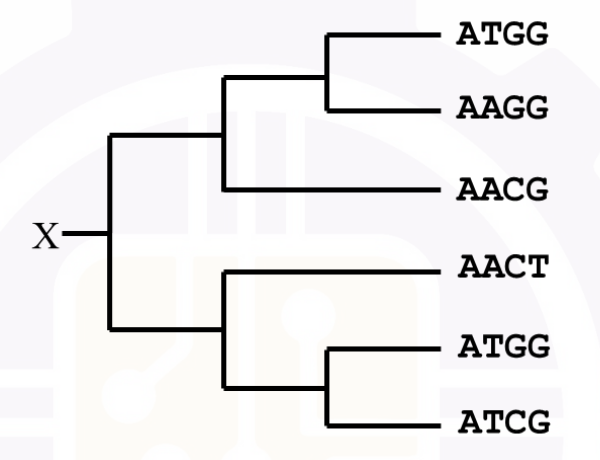
The phylogeny below shows the relationship between six species based on whole genome data. The sequence of a part of a particular gene from each species is provided at the tips of the tree. Based on the principle of parsimony, which one of the following is the expected sequence for the ancestor X?
A phylogenetic tree for the evolution of two pigmentation traits in species of fish is shown for clades X, Y and Z. Genes A and/or B, if mutated, can cause dark pigmentation in the body.
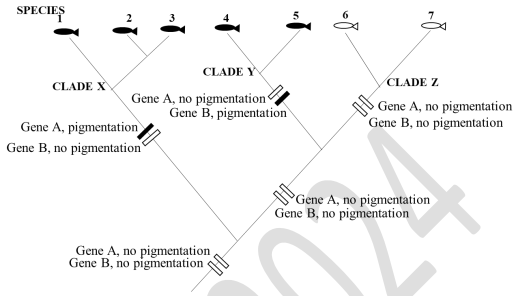
Which one or more of the following statements is/are correct?- Which of the following trees is phylogenetically MOST accurate?


