
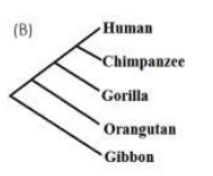
Phylogenetic Tree Accuracy Explained
A phylogenetic tree visually represents the evolutionary history and relationships between different biological species or groups. The accuracy of a phylogenetic tree depends on how well it reflects the actual evolutionary pathways and groupings (clades) supported by scientific evidence.
Analyzing Tree Accuracy
The question asks for the MOST accurate phylogenetic tree. Evaluating accuracy involves assessing:
- Clarity of Relationships: How clearly the branching pattern shows common ancestry.
- Monophyletic Groupings: Whether the tree correctly groups organisms that share a common ancestor and all its descendants (clades).
- Consistency with Data: How well the depicted relationships align with broader evolutionary data (morphological, genetic, fossil records).
Evaluating the Options
Option B presents the most accurate phylogenetic tree. While the other options may depict some relationships, Option B offers the clearest and most scientifically consistent representation of evolutionary connections. It likely illustrates well-defined monophyletic groups and a branching pattern that aligns best with established evolutionary biology principles.
The specific structure in Option B effectively conveys the hierarchical nature of evolution and the divergence of lineages from common ancestors, making it the most reliable depiction among the choices.
Important Questions from Phylogenetic trees
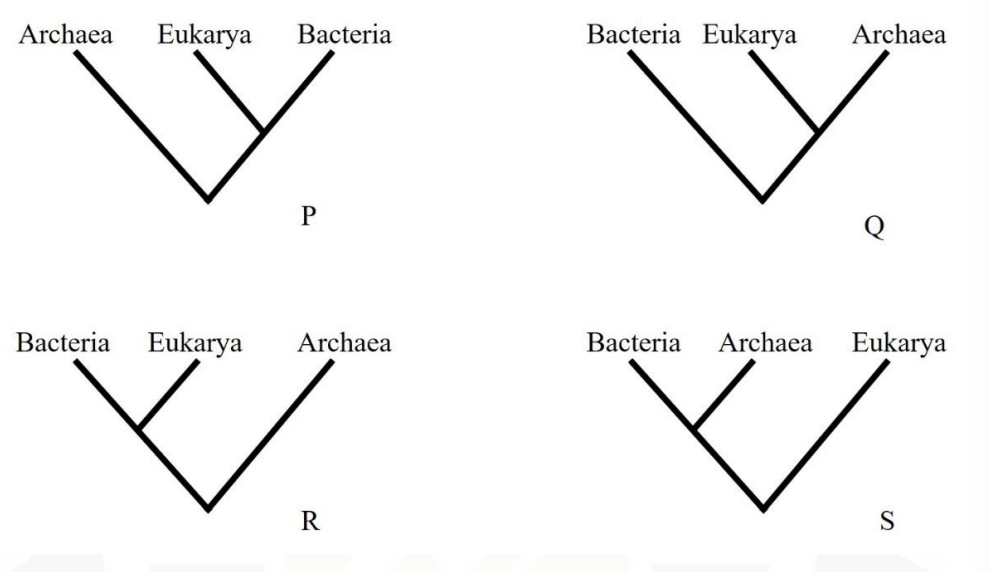
Which one of the following phylogenetic trees illustrates the relationship between Archaea, Bacteria and Eukarya?
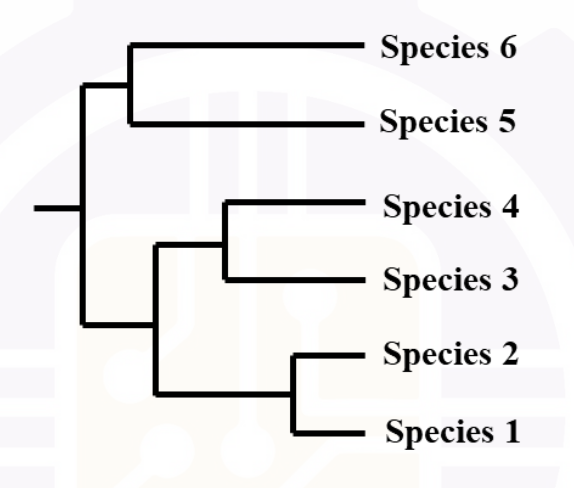
The phylogeny of six species of birds is illustrated below, where the horizontal branch lengths correspond to genetic distance. These six species are distributed in three islands X, Y, and Z. Island X harbours species 1, 4, 6; Island Y harbours species 1, 2, 4; and Island Z harbours species 3, 4, 5. Which one of the following is true about the phylogenetic diversity of these islands?
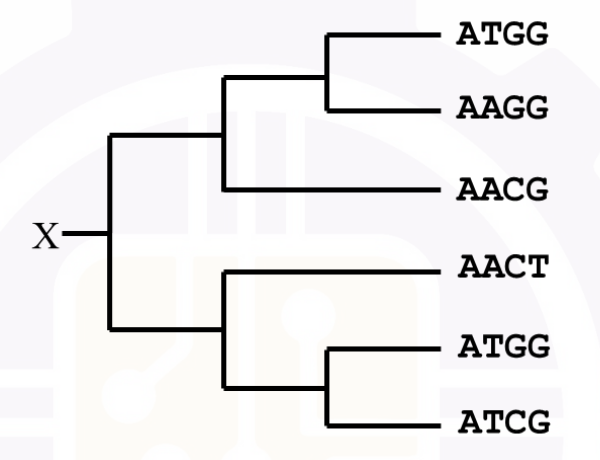
The phylogeny below shows the relationship between six species based on whole genome data. The sequence of a part of a particular gene from each species is provided at the tips of the tree. Based on the principle of parsimony, which one of the following is the expected sequence for the ancestor X?
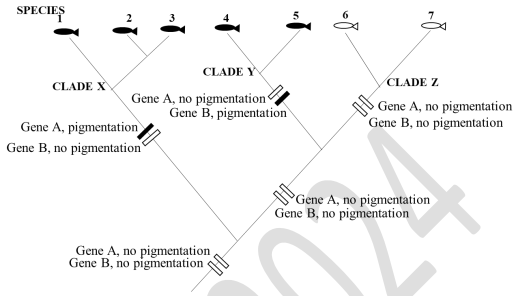
A phylogenetic tree for the evolution of two pigmentation traits in species of fish is shown for clades X, Y and Z. Genes A and/or B, if mutated, can cause dark pigmentation in the body.
Which one or more of the following statements is/are correct?- Whales and dolphins are hypothesized to have evolved along the northern shore of the Tethys Sea, prior to the Indian plate's collision with the Eurasian plate. To which one of the following animals are these aquatic mammals most closely related?


