
Understanding Genetic Drift Effects
Genetic drift refers to random fluctuations in allele frequencies within a population from one generation to the next. These changes are due to chance events, not natural selection.
Analyzing Genetic Drift Statements
Let's evaluate each statement regarding genetic drift:
-
Statement 1: "Like mutation, drift increases genetic variation within a population."
This is inaccurate. While mutation introduces new genetic variation, genetic drift tends to reduce genetic variation within a population by causing some alleles to become fixed (frequency 1.0) and others to be lost (frequency 0.0) purely by chance.
-
Statement 2: "Drift typically increases genetic differences between populations."
This is accurate. Because drift causes random changes in allele frequencies, different populations subjected to drift will diverge over time. Allele frequencies will fluctuate independently in each isolated population, leading to increased genetic differences between them.
-
Statement 3: "Drift typically reinforces the effects of natural selection in populations."
This is inaccurate. Genetic drift is a random process and can often counteract the directional effects of natural selection, especially in smaller populations. It does not typically reinforce selection.
-
Statement 4: "Drift increases with population size, leading to faster evolution."
This is inaccurate. The effect of genetic drift is inversely related to population size. Drift causes significant changes in allele frequencies in small populations, while its impact is minimal in large populations.
- Statement 5: (No statement provided)
Therefore, the only accurate statement describing genetic drift is that it typically increases genetic differences between populations.
Important Questions from Genetic drift
- A few years ago, a very small population of zebrafish became isolated by a newly built dam. As a result, which statement is most likely to be true about this population of zebrafish now?
- Which two of the following processes can result in a decline in heterozygosity in populations?
I) inbreeding; II) genetic drift; III) mutation; IV) random mating In a population of birds on an island, the average beak size reduced over one generation. A researcher estimated the association between beak size and relative fitness, shown in the graph. The estimated slope was –0.05 with a 95% confidence interval of -0.15 to 0.09.
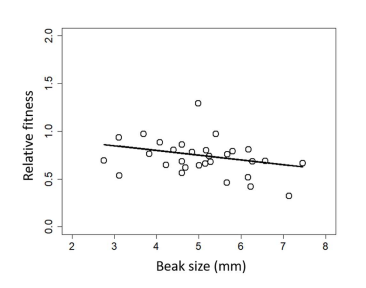
Which one of the following evolutionary processes acting on beak size is the most likely reason for the observed reduction in beak size?
- Two isolated populations X and Y have 100 and 10000 individuals, respectively. Both populations have the same starting allele frequencies of p=0.5 and q=0.5. After 1000 generations of genetic drift, which of the following statements is true about the heterozygosity at this locus in these two populations?
- In a population of 100 individuals of a diploid organism with 1:1 sex ratio, the probability of fixation of a new neutral mutation is ______ (round off to three decimal places).


