
In a population of birds on an island, the average beak size reduced over one generation. A researcher estimated the association between beak size and relative fitness, shown in the graph. The estimated slope was –0.05 with a 95% confidence interval of -0.15 to 0.09. Which one of the following evolutionary processes acting on beak size is the most likely reason for the observed reduction in beak size?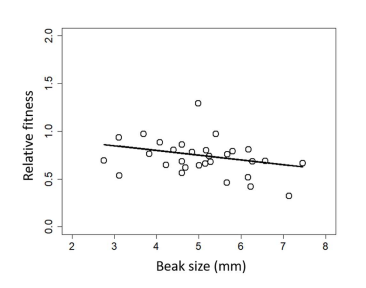
To determine the evolutionary process most likely responsible for the observed reduction in beak size, we need to analyze the information provided:
-
The slope of the association between beak size and relative fitness is estimated to be -0.05. This means that as beak size increases, the relative fitness decreases slightly. However, the confidence interval for this slope is -0.15 to 0.09, which includes zero. This indicates that the relationship is not statistically significant. Therefore, this weak association suggests that natural selection based on beak size is not a strong driver in this context.
-
Understanding the options provided:
- Genetic Drift: This refers to random fluctuations in allele frequencies within a population. It is significant in small populations and can lead to changes in traits that are not due to natural selection.
- Group Selection: This is a process where natural selection acts at the group level rather than the individual, rare in nature.
- Kin Selection: This focuses on the genetic success derived from cooperation with relatives, not directly relevant to beak size reduction without direct kin influence.
- Natural Selection: This involves differential survival and reproduction of individuals due to differences in phenotype. Given the weak slope and confidence interval, natural selection is not strongly indicated here.
-
Since the slope is weak and the confidence interval includes zero, indicating no strong selection pressure, the most likely explanation is Genetic Drift. This is because genetic drift can lead to changes in traits without any specific selection pressure, particularly in a small isolated population such as on an island.
Thus, the best explanation for the observed reduction in beak size is Genetic Drift.
Important Questions from Genetic drift
- In a diploid population of N individuals, the probability of fixation of a new neutral mutation (assuming no other mutation occurs) is _________.
- Two isolated populations M and N have population sizes of 100 and 1000 individuals, respectively. The starting allele frequencies p and q are 0.5 in both populations. Assuming no selection, which one of the following is expected after 100 generations?
- A few years ago, a very small population of zebrafish became isolated by a newly built dam. As a result, which statement is most likely to be true about this population of zebrafish now?
- Which two of the following processes can result in a decline in heterozygosity in populations?
I) inbreeding; II) genetic drift; III) mutation; IV) random mating - Which of the following processes typically does NOT contribute to increase in genetic variation?


