
Which one of the following represents the correct feasible region determined by the following constraints of an LPP? \( x + y \geq 10, \quad 2x + 2y \leq 25, \quad x \geq 0, \quad y \geq 0 \)
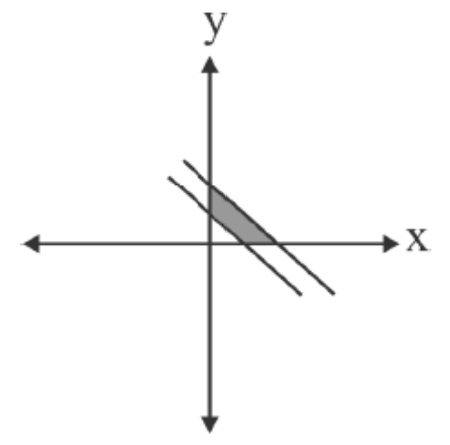
Let’s verify quickly whether option (3) is correct for the LPP constraints:
Given:
x + y ≥ 10
2x + 2y ≤ 25 ⇒ x + y ≤ 12.5
x ≥ 0, y ≥ 0
Step 1: Interpret the constraints
We get:
10 ≤ x + y ≤ 12.5
So the feasible region is:
Above the line x + y = 10
Below the line x + y = 12.5
Only in the first quadrant (x ≥ 0, y ≥ 0)
Step 2: Nature of region
This forms a strip between two parallel lines in the first quadrant, not a triangular region and not touching the origin.
So:
It is NOT a region near origin (so options like (2) and (4) are wrong)
It is NOT just one line strip without shading properly bounded (so (3) must be checked carefully)
Step 3: Checking option (3)
Option (3) shows:
A band between two parallel lines
Located in the first quadrant
Not touching origin
Proper strip-type feasible region
This matches exactly the condition:
10 ≤ x + y ≤ 12.5 in first quadrant
Final Answer:
Yes, option (3) is correct.
Important Questions from Relations and Functions
If the function \( f: \mathbb{N} \to \mathbb{N} \) is defined as
\( f(n) = \begin{cases} n - 1, & \text{if } n \text{ is even} \\ n + 1, & \text{if } n \text{ is odd} \end{cases} \)
then:
(A) \( f \) is injective
(B) f is into
(C) f is surjective
(D) f is invertible
Choose the correct answer from the options given below :
Let [x] denote the greatest integer function. Then match List-I with List-II:
List-I List-II (A) |x - 1| + |x - 2| (I) is differentiable everywhere except at x = 0 (B) x - |x| (II) is continuous everywhere (C) x - [x] (III) is not differentiable at x = 1 (D) x |x| (IV) is differentiable at x = 1 Choose the correct answer from the options given below:
Let \( R \) be the relation on \( \mathbb{N} \) (set of natural numbers) defined by \( R = \{(a, b) : a, b \in \mathbb{N} \) and \( b \) is divisible by \( a\} \). Then the relation \( R \) is:
If \( f: \mathbb{R} \to \mathbb{R} \) is a function given by \( f(x) = \lfloor x \rfloor \) (greatest integer function), then which of the following is/are correct?
- (a) \( f \) is one-one
- (b) \( f \) is not onto
- (c) Range of \( f \) is \( \mathbb{I} \) (set of integers)
- (d) \( f(2.5) = 2 \)
- (e) \( f \) is bijective
Choose the correct answer from the options given below:
If \( m \) and \( M \) are respectively minimum and maximum values of \( f(x) = |2 - |x|| \), for \( -3 \leq x \leq 3 \), then:


