Given, $O_1, O_2, \dots, O_n$ are the observed values, $E_1, E_2, \dots, E_n$ are the corresponding expected values, $\bar{O}$ is the mean of observed values, $n$ is the number of observations, $\mu$ is the mean of $E_i, i = 1, \dots, n$, $\sigma_o$ is the standard deviation of observed values, and $\sigma_E$ is the standard deviation of expected values $E_i, i = 1, \dots, n$.
Chi-Square ($\chi^2$) Test Formula Identification
The Chi-Square ($\chi^2$) test is a statistical method used to determine if there is a significant difference between expected frequencies and observed frequencies in one or more categories. It is commonly used in hypothesis testing, particularly for goodness-of-fit tests and tests of independence.
Correct Chi-Square ($\chi^2$) Formula
The universally accepted formula for the Chi-Square ($\chi^2$) statistic is:
$ \chi^2 = \sum_{i=1}^{n} \frac{(O_i - E_i)^2}{E_i} $
Where:
- $O_i$ represents the observed frequency for category $i$.
- $E_i$ represents the expected frequency for category $i$.
- $n$ is the number of categories or observations.
- The summation ($\sum$) is performed across all categories from $i=1$ to $n$.
This formula calculates the sum of the squared differences between observed and expected values, divided by the expected values. This ratio quantifies how well the observed data fit the expected distribution.
Analysis of Other Options
The other options provided represent different statistical formulas:
- Option 2: $\chi^2 = \sqrt{\frac{\sum_{i=1}^{n}(O_i - \bar{O})}{n-1}}$ does not represent a standard Chi-Square formula. It incorrectly uses a square root and a numerator structure that does not align with Chi-Square calculations.
- Option 3: $\chi^2 = \frac{\bar{O} - \mu}{\sigma_o / \sqrt{n}}$ is characteristic of a Z-test or t-test formula, used for comparing a sample mean to a population mean or testing hypotheses about means, not for categorical data analysis like the Chi-Square test.
- Option 4: $\chi^2 = \frac{(\sigma_o)^2}{(\sigma_E)^2}$ represents a ratio of variances, which is related to F-tests but is not the Chi-Square test formula.
Therefore, the formula that correctly represents the Chi-Square ($\chi^2$) test statistic is the one summing the squared deviations of observed from expected frequencies, scaled by expected frequencies.
Important Questions from Error Analysis
The calibration graph between absorbance and the concentration of chromate (CrO$_4^{2-}$) in a water sample is shown in the figure.
The equation of the line is $y = 0.8003x + 0.0055$.
For an absorbance of 0.35 in a water sample, the estimated Cr(VI) concentration is ______ mg/L (rounded off to two decimal places).
Use the atomic weight (g/mol) of Cr and O as 52 and 16, respectively.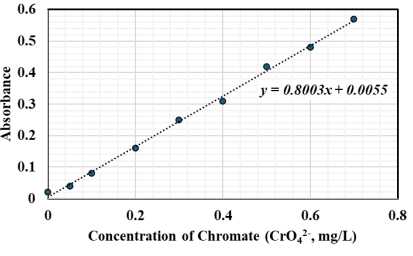
A digital counter increments its count every $0.1\ \mu\text{s}$. The counter is used in an instrument to measure frequency. The counter is operated for one period of the input signal to the instrument to measure its frequency. The input signal is approximately at $100\text{ kHz}$. The maximum error in the measured frequency is _____ kHz.
(rounded off to the nearest integer)
- The length of a highway was measured in 10 equal sections. If the precision of the individual section measurements is $\sigma$, then what is the precision of the measured length of the highway?
- A trapezoidal land parcel for a residential plot measures 10.335 m in the south, 13.971 m in the north, 5.047 m in the west and 6.302 m in the east directions. The north and south sides are perpendicular to the western side of the plot, making the eastern side skewed. Given the lengths of the sides are measured with a precision of 1 mm, the precision of the area of the plot calculated from these measurements is __________ $\text{m}^2$ (Rounded off to two decimal values).
Hint: Area of a trapezium $= \left(\frac{\text{sum of parallel sides}}{2}\right) \times \text{height}$ Identify the type of error the instrument shows as in the given figure.