
To determine the precision of the measured length of the highway, considering that it is divided into 10 equal sections, we must understand how measurement errors propagate when summing multiple measurements.
- Assume each section of the highway is measured with an individual precision of \(\sigma\). This represents the standard deviation or the uncertainty in measuring one section.
- When measurements of independent sections are added, the uncertainties add up in quadrature. This means the total standard deviation (precision of the total measurement) is calculated using the formula for the standard deviation of the sum of independent random variables: \(\sqrt{\sigma_1^2 + \sigma_2^2 + \cdots + \sigma_n^2}\).
- In this problem, each section has the same precision \(\sigma\). Since there are 10 sections, we calculate the precision of the total length as: \(\sqrt{10\sigma^2} = \sigma\sqrt{10}\).
- This means the precision of the measured total length of the highway is \(\sigma\sqrt{10}\).
Therefore, the correct option is \(\sigma\sqrt{10}\). The other options can be eliminated because they do not correctly represent how standard deviations aggregate for sums of measurements:
- \(\sigma/\sqrt{10}\) suggests a reduction in error which occurs during averaging, not summing.
- \(10\sigma\) would imply a summing of errors linearly without considering the random nature of measurement error.
- \(\sigma/10\) implies a division error typically associated with averaging divided measurements, not compiling them additively.
Important Questions from Error Analysis
The calibration graph between absorbance and the concentration of chromate (CrO$_4^{2-}$) in a water sample is shown in the figure.
The equation of the line is $y = 0.8003x + 0.0055$.
For an absorbance of 0.35 in a water sample, the estimated Cr(VI) concentration is ______ mg/L (rounded off to two decimal places).
Use the atomic weight (g/mol) of Cr and O as 52 and 16, respectively.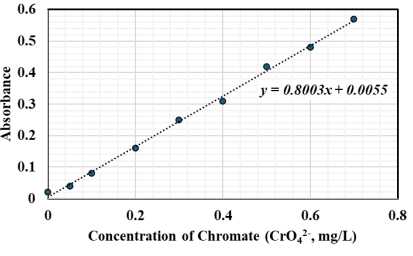
A digital counter increments its count every $0.1\ \mu\text{s}$. The counter is used in an instrument to measure frequency. The counter is operated for one period of the input signal to the instrument to measure its frequency. The input signal is approximately at $100\text{ kHz}$. The maximum error in the measured frequency is _____ kHz.
(rounded off to the nearest integer)
- A trapezoidal land parcel for a residential plot measures 10.335 m in the south, 13.971 m in the north, 5.047 m in the west and 6.302 m in the east directions. The north and south sides are perpendicular to the western side of the plot, making the eastern side skewed. Given the lengths of the sides are measured with a precision of 1 mm, the precision of the area of the plot calculated from these measurements is __________ $\text{m}^2$ (Rounded off to two decimal values).
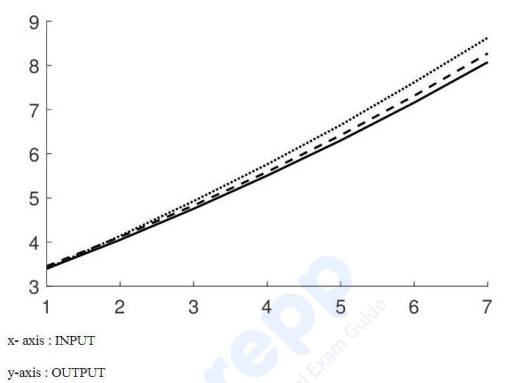
Hint: Area of a trapezium $= \left(\frac{\text{sum of parallel sides}}{2}\right) \times \text{height}$ Identify the type of error the instrument shows as in the given figure.
Determine the absolute error of measurement if measured value of a resistance = 20.65 Ω and true value = 20.55 Ω.


