
$$ \int_{0}^{1} e^{-x^2} dx $$
Note: Use numerical integration
Integral Approximation using Numerical Methods
The question asks for an approximate value of the definite integral $ \int_{0}^{1} e^{-x^2} dx $. We are advised to use numerical integration.
A straightforward numerical integration method is the Trapezoidal Rule. Let's apply it with a single interval ($n=1$) for simplicity.
Trapezoidal Rule Application
The Trapezoidal Rule formula for approximating $ \int_{a}^{b} f(x) dx $ with $n$ intervals is:
$ \int_{a}^{b} f(x) dx \approx \frac{b-a}{2n} [f(a) + 2 \sum_{i=1}^{n-1} f(x_i) + f(b)] $In this case:
- The function is $ f(x) = e^{-x^2} $.
- The limits of integration are $ a=0 $ and $ b=1 $.
- We choose $ n=1 $.
With $n=1$, the formula simplifies to:
$ \int_{0}^{1} e^{-x^2} dx \approx \frac{1-0}{2(1)} [f(0) + f(1)] $Now, we evaluate the function at the limits:
- $ f(0) = e^{-0^2} = e^0 = 1 $
- $ f(1) = e^{-1^2} = e^{-1} = \frac{1}{e} $
Substitute these values back into the approximation formula:
$ \int_{0}^{1} e^{-x^2} dx \approx \frac{1}{2} [1 + \frac{1}{e}] $Simplify the expression:
$ \approx \frac{1}{2} \times 1 + \frac{1}{2} \times \frac{1}{e} $ $ = \frac{1}{2} + \frac{1}{2e} $ $ = \frac{e}{2e} + \frac{1}{2e} $ $ = \frac{e+1}{2e} $This approximation matches Option C.
Important Questions from Calculus
Given $y = x^2+x+6$, the value of $\frac{d}{dx}(\ln y)$ at $x=2$ is ________________.
The slope of the function \( y = x - x^{2} \) at \( x = 1 \) is ____________
Water flows over a plate of finite length. At $x = x_1$ from the leading edge, the velocity of the flow is $V_x = 0.5y - 0.5y^3$. The thickness, $\delta$ (in meter) of the boundary layer at $x = x_1$ is: _________ (round off to 2 decimal places).
Given: $V_\infty$ is the free stream velocity.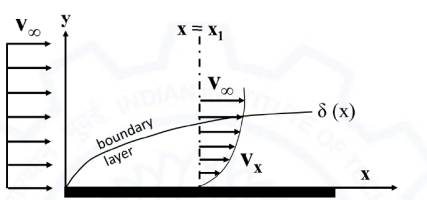
- The power series expansion of a function is given as
$\frac{1}{x}\ln(1 + x) = 1 + bx + cx^2 + \dots$
for $0 < x \le 1$.
The values of constants $b$ and $c$, respectively, are - Given, $z (x, y) = e^{x-2y}$, where $x(t) = e^t$ and $y(t) = e^{-t}$. All the variables are real. The total differential $\frac{dz}{dt}$ is


