
Calculating Total Differential using Chain Rule
We are given the function $z(x, y) = e^{x-2y}$ and the relations $x(t) = e^t$ and $y(t) = e^{-t}$. We need to find the total differential $\frac{dz}{dt}$.
Applying the Chain Rule
For a function $z$ depending on $x$ and $y$, where $x$ and $y$ depend on $t$, the chain rule for the total differential is:
$ \frac{dz}{dt} = \frac{\partial z}{\partial x} \frac{dx}{dt} + \frac{\partial z}{\partial y} \frac{dy}{dt} $
Step 1: Calculate Partial Derivatives of z
- Partial derivative with respect to x: $ \frac{\partial z}{\partial x} = \frac{\partial}{\partial x}(e^{x-2y}) = e^{x-2y} \cdot (1) = z $
- Partial derivative with respect to y: $ \frac{\partial z}{\partial y} = \frac{\partial}{\partial y}(e^{x-2y}) = e^{x-2y} \cdot (-2) = -2z $
Step 2: Calculate Total Derivatives of x and y
- Derivative of x with respect to t: $ \frac{dx}{dt} = \frac{d}{dt}(e^t) = e^t = x $
- Derivative of y with respect to t: $ \frac{dy}{dt} = \frac{d}{dt}(e^{-t}) = e^{-t} \cdot (-1) = -e^{-t} = -y $
Step 3: Substitute into the Chain Rule Formula
Substitute the calculated derivatives back into the chain rule equation:
$ \frac{dz}{dt} = (z)(x) + (-2z)(-y) $
Step 4: Simplify the Expression
Simplify the resulting expression:
$ \frac{dz}{dt} = zx + 2zy $
Factor out $z$:
$ \frac{dz}{dt} = z(x + 2y) $
Therefore, the total differential $\frac{dz}{dt}$ is $z(x + 2y)$.
Important Questions from Calculus
Given $y = x^2+x+6$, the value of $\frac{d}{dx}(\ln y)$ at $x=2$ is ________________.
The slope of the function \( y = x - x^{2} \) at \( x = 1 \) is ____________
Water flows over a plate of finite length. At $x = x_1$ from the leading edge, the velocity of the flow is $V_x = 0.5y - 0.5y^3$. The thickness, $\delta$ (in meter) of the boundary layer at $x = x_1$ is: _________ (round off to 2 decimal places).
Given: $V_\infty$ is the free stream velocity.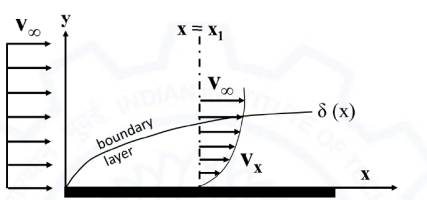
- The power series expansion of a function is given as
$\frac{1}{x}\ln(1 + x) = 1 + bx + cx^2 + \dots$
for $0 < x \le 1$.
The values of constants $b$ and $c$, respectively, are - The Cartesian coordinates (x, y) of a point A with polar coordinates $(4, \frac{\pi}{4})$ is


