
$\frac{1}{x}\ln(1 + x) = 1 + bx + cx^2 + \dots$
for $0 < x \le 1$.
The values of constants $b$ and $c$, respectively, are
$-\frac{1}{2}$ and $\frac{1}{3}$
Power Series Derivation
The problem requires finding the constants $b$ and $c$ from the given power series expansion:
$ \frac{1}{x}\ln(1 + x) = 1 + bx + cx^2 + \dots $
We start with the known Maclaurin series for the natural logarithm function $\ln(1 + x)$:
$ \ln(1 + x) = x - \frac{x^2}{2} + \frac{x^3}{3} - \frac{x^4}{4} + \dots $
This series converges for $-1 < x \le 1$. The question considers the interval $0 < x \le 1$.
To find the series for $\frac{1}{x}\ln(1 + x)$, we divide the series term-by-term by $x$:
$ \frac{1}{x}\ln(1 + x) = \frac{1}{x} \left( x - \frac{x^2}{2} + \frac{x^3}{3} - \frac{x^4}{4} + \dots \right) $
$ \frac{1}{x}\ln(1 + x) = 1 - \frac{x}{2} + \frac{x^2}{3} - \frac{x^3}{4} + \dots $
Identifying Coefficients b and c
Now, we equate this derived series with the given series form $1 + bx + cx^2 + \dots$:
$ 1 - \frac{1}{2}x + \frac{1}{3}x^2 - \dots = 1 + bx + cx^2 + \dots $
By comparing the coefficients of the corresponding powers of $x$ on both sides of the equation:
- The coefficient of $x$ gives: $b = -\frac{1}{2}$
- The coefficient of $x^2$ gives: $c = \frac{1}{3}$
Thus, the values of the constants are $b = -\frac{1}{2}$ and $c = \frac{1}{3}$.
Important Questions from Calculus
Given $y = x^2+x+6$, the value of $\frac{d}{dx}(\ln y)$ at $x=2$ is ________________.
The slope of the function \( y = x - x^{2} \) at \( x = 1 \) is ____________
Water flows over a plate of finite length. At $x = x_1$ from the leading edge, the velocity of the flow is $V_x = 0.5y - 0.5y^3$. The thickness, $\delta$ (in meter) of the boundary layer at $x = x_1$ is: _________ (round off to 2 decimal places).
Given: $V_\infty$ is the free stream velocity.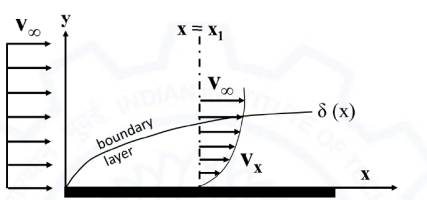
- Given, $z (x, y) = e^{x-2y}$, where $x(t) = e^t$ and $y(t) = e^{-t}$. All the variables are real. The total differential $\frac{dz}{dt}$ is
- The Cartesian coordinates (x, y) of a point A with polar coordinates $(4, \frac{\pi}{4})$ is


