
Understanding Electron Wave Nature Experiments
The question asks us to identify which of the listed experiments does not confirm the wave nature of the electron. Electrons, like other quantum entities, exhibit wave-particle duality, meaning they can behave as both particles and waves depending on the experiment. Several key experiments have demonstrated this dual nature.
Analyzing Experiments Confirming Electron Wave Nature
- Davisson and Germer experiment: This landmark experiment in 1927 provided strong evidence for the wave nature of electrons. Davisson and Germer observed the diffraction pattern of electrons scattered from a nickel crystal surface. This diffraction pattern is a characteristic phenomenon of waves, similar to how X-rays diffract from crystals. The observed pattern matched the predictions based on the de Broglie hypothesis, which proposed that particles like electrons have associated wavelengths (de Broglie wavelength, $\lambda = h/p$, where $h$ is Planck's constant and $p$ is momentum).
- G. P. Thomson's experiment: George Paget Thomson conducted experiments around the same time, firing electrons through thin metal foils (like gold foil). He observed concentric rings, similar to those produced by X-ray diffraction. This confirmed that electrons diffract when passing through the crystalline structure of the foil, providing further evidence for their wave nature. His work earned him the Nobel Prize in Physics in 1937, shared with Davisson.
- Young's double-slit experiment (with electrons): Although originally performed with light to demonstrate its wave nature, this experiment has been successfully performed with electrons. When a beam of electrons is directed towards two narrow slits, an interference pattern is observed on a screen behind the slits. This pattern of alternating bright and dark fringes (or high and low probability regions for electrons) can only be explained by the wave-like interference of the electron probability wave passing through both slits simultaneously.
Examining the Photoelectric Effect
The Photoelectric effect describes the phenomenon where electrons are ejected from a metal surface when light shines on it. Albert Einstein explained this effect in 1905 by proposing that light itself is quantized into discrete packets of energy called photons. Each photon carries energy $E = hf$, where $h$ is Planck's constant and $f$ is the frequency of the light.
Key aspects of the photoelectric effect:
- It demonstrates the particle nature of light (photons).
- It shows that the energy of the ejected electrons depends on the frequency of the incident light and the work function of the metal, not the intensity of the light (above a threshold frequency).
- While electrons are emitted (particles), the effect itself is primarily explained through the interaction of light quanta with electrons and the resulting electron emission. It doesn't directly showcase phenomena like diffraction or interference that are unequivocally wave behaviors of the electrons themselves, unlike the other experiments listed. The photoelectric effect confirms the particle nature of light and the quantum nature of energy transfer.
Conclusion
Experiments like Davisson-Germer, G. P. Thomson's, and the double-slit experiment using electrons directly show wave phenomena (diffraction and interference) associated with electrons. The photoelectric effect, however, is primarily explained by the particle nature of light (photons) and the subsequent emission of electrons. Therefore, the photoelectric effect does not confirm the wave nature of the electron.
Important Questions from Miscellaneous
- An electromagnetic wave with its magnetic field $B = 0.3\cos(ky-10^8t)i$ tesla is propagating in a non-magnetic dielectric medium of refractive index 2. The wavelength of the wave is
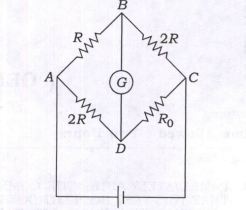
For a given system of resistors having resistances R, 2R, R$_0$ and 2R (shown in the figure), what will be the value of resistance of the resistor R$_0$, when there is NO current in the galvanometer G?
- A cyclotron has an oscillator frequency of $12\times10^6$ Hz and 'Dee' radius of 21 inches. The value of magnetic induction (field) needed to accelerate a deuteron (mass = $3.34 \times 10^{-27}$ kg and charge = $1.6\times10^{-19}$ C) is
- When white light propagating in air passes through a glass prism, it splits into a band of colours referred to as the white light spectrum. This phenomenon is called the dispersion of light. Among the following colours, the angle of deviation will be the highest in
- Why do we prefer to have a liquid and not a gas to be used as the fluid in a hydraulic machine?


