
Which one of the following demands states consumers are adequately buying all the products put into the marketplace?
Full demand
Understanding Different Types of Market Demand
In marketing, understanding consumer demand is crucial for businesses to effectively manage their products and strategies. Demand isn't always the same; it can vary based on consumer desire, market conditions, and the availability of products. Marketers often classify demand into different states.
Analyzing the Question: Consumers Buying All Products
The question asks for the specific type of demand where consumers are buying all the products that a company puts into the marketplace. This scenario implies a balance where the quantity of goods supplied perfectly matches the quantity demanded by consumers. Let's look at the given options to find the one that describes this situation.
Exploring the Demand States
Here are the common states of demand discussed in marketing:
- Overfull demand: This happens when demand is higher than what the company can or wants to supply. The market is asking for more products than are available.
- Full demand: This occurs when the level of demand is equal to the level of supply. Consumers are buying all the products that are offered.
- Irregular demand: Demand varies significantly over time, such as seasonally (like holiday decorations), monthly (like utilities), or daily (like public transport during rush hour).
- Latent demand: Consumers have a strong need or desire for something that existing products or services do not satisfy. The demand is not yet visible because no suitable product exists.
Based on these definitions, the state where consumers are buying all the products put into the marketplace perfectly matches the definition of Full demand.
| Demand State | Description |
|---|---|
| Overfull demand | Demand > Supply |
| Full demand | Demand = Supply |
| Irregular demand | Demand fluctuates over time |
| Latent demand | Unsatisfied need exists |
Why Full Demand is the Correct Answer
The question describes a scenario where the quantity demanded by consumers precisely absorbs the quantity supplied by the producer. This balanced state is the defining characteristic of Full demand. In this situation, the company is operating at its desired capacity, and there is no shortage or surplus of products in the market.
Revision Table: Marketing Demand Concepts
| Demand Type | Market Situation | Marketing Task |
|---|---|---|
| Negative Demand | Consumers dislike the product and may even pay to avoid it. | Convert demand (e.g., through redesign, lower prices). |
| No Demand | Consumers are unaware of or uninterested in the product. | Create demand (e.g., through marketing communication). |
| Latent Demand | Consumers have a need that isn't met by existing products. | Develop demand (e.g., create new products). |
| Declining Demand | Demand for the product is falling. | Revitalize demand (e.g., find new target markets, features). |
| Irregular Demand | Demand varies on a seasonal, monthly, or daily basis. | Synchronize demand (e.g., flexible pricing, promotion during low periods). |
| Full Demand | Consumers are adequately buying all products put into the marketplace. | Maintain demand (e.g., monitor competition, maintain quality). |
| Overfull Demand | Demand is higher than the company can handle. | Demarket demand (e.g., raise prices, reduce promotion). |
| Unwholesome Demand | Consumers are attracted to products that are harmful (e.g., cigarettes, illegal drugs). | Counter demand (e.g., public awareness campaigns, legal action). |
Additional Information on Demand States
Understanding these different states of demand is fundamental for marketers. Each state requires a different marketing approach or task. For example, dealing with overfull demand involves "demarketing" – trying to reduce demand temporarily or permanently. In contrast, dealing with no demand requires stimulating interest and awareness.
Achieving and maintaining Full demand is often considered an ideal state for a business, as it signifies efficient operations and a good match between supply and market needs. However, market conditions are dynamic, and demand can shift from one state to another, requiring continuous monitoring and adaptation of marketing strategies.
Important Questions from Demand analysis
- If the gross elasticity of demand is negative, the two products in consideration are __________ products.
- For a linear demand curve, which of the following is true ?
In the above diagram, if curve IC represents income - consumption curve, then it means that :
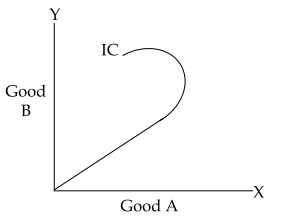
- A consumer spends ₹ 240 when the price of the commodity is ₹ 15 and ₹ 300 when the price rises to ₹ 20. The elasticity of demand is :
Given below are two statements. one labelled as Assertion (A) and the other labelled as Reason (R).
Assertion (A): Auto companies and other consumer goods companies offer cash rebates to encourage purchase of the manufacturer's products within a specified period
Reason (R): The same product is priced differently at different times
In the context of the two statements above related to pricing strategy, which one of the following options is correct?


