
Given below are two statements. one labelled as Assertion (A) and the other labelled as Reason (R). Assertion (A): Auto companies and other consumer goods companies offer cash rebates to encourage purchase of the manufacturer's products within a specified period Reason (R): The same product is priced differently at different times In the context of the two statements above related to pricing strategy, which one of the following options is correct?
(A) is correct, but (R) is not correct
Analyzing Assertion and Reason in Pricing Strategy
The question asks us to evaluate two statements related to pricing strategy: an Assertion (A) about cash rebates and a Reason (R) about products being priced differently at different times. We need to determine if each statement is correct and if the Reason correctly explains the Assertion in this context.
Examining Assertion (A)
Assertion (A): Auto companies and other consumer goods companies offer cash rebates to encourage purchase of the manufacturer's products within a specified period.
Let's consider this statement about cash rebates:
- Cash rebates are a common marketing and sales promotion tool.
- They involve giving back a portion of the purchase price to the customer.
- They are typically offered for a limited time or on specific models or products.
- The main goal is to incentivize customers to buy the product sooner rather than later, increasing sales volume during the offer period.
Offering cash rebates to boost sales within a specific timeframe is a widely used and effective strategy by companies, including auto manufacturers and consumer goods firms. Therefore, Assertion (A) is a correct statement regarding a common business practice in pricing and sales promotion.
Examining Reason (R) and its relation to Assertion (A)
Reason (R): The same product is priced differently at different times.
Let's consider this statement about dynamic pricing or price variation over time:
- It is true that some products or services are priced differently depending on factors like time of day, season, demand levels, or other conditions. This is known as dynamic pricing.
- Examples include airline tickets, hotel rooms, or even ride-sharing services.
Now, let's evaluate if this Reason (R) explains Assertion (A):
- Assertion (A) is about using cash rebates as an incentive for purchases within a specific period.
- Reason (R) states that prices change over time.
- While a cash rebate does result in the customer paying less than the full price during the offer period, the core reason for offering the rebate is not simply that the base price changes over time. The rebate is a specific, temporary promotional tool applied often to a standard price, designed to achieve specific sales goals like clearing inventory, boosting demand, or promoting a new product.
- Dynamic pricing (pricing differently at different times) is a broader concept that might involve fundamental changes to the list price based on temporal factors, independent of a specific promotional rebate offer.
- Reason (R) does not directly explain *why* companies use cash rebates. The existence of general price variation over time (R) is not the underlying cause or justification for using a targeted, time-bound cash rebate program (A).
Therefore, while statement (R) about prices changing over time can be true in some contexts, it is not the correct reason for companies offering cash rebates as described in Assertion (A).
Conclusion on the Statements
Based on the analysis:
- Assertion (A) is correct because companies do use cash rebates as a temporary incentive to encourage purchases.
- Reason (R) is not correct as a reason for Assertion (A), because the general phenomenon of prices changing over time does not explain the strategic use of targeted cash rebates for specific promotional goals.
Thus, Assertion (A) is correct, but Reason (R) is not correct in the context presented.
| Statement | Evaluation | Explanation |
|---|---|---|
| Assertion (A): Cash rebates offered to encourage purchase within a period. | Correct | Common and effective sales promotion strategy to boost sales temporarily. |
| Reason (R): Same product priced differently at different times. | Not Correct (as a reason for A) | Describes dynamic pricing, which is distinct from the purpose of using a cash rebate as a promotional tool. R does not explain A. |
Revision Table: Key Concepts
| Term | Definition/Purpose | Relation to Question |
|---|---|---|
| Cash Rebate | Partial refund offered to a customer after purchase, typically requiring proof of purchase and application. | The core of Assertion (A), used for temporary sales boosts. |
| Sales Promotion | Marketing activities designed to stimulate immediate purchases by consumers or trade intermediaries. | Cash rebates are a type of sales promotion. |
| Pricing Strategy | Methods companies use to set prices for their products or services. | Both cash rebates (as a temporary price adjustment/incentive) and dynamic pricing relate to pricing strategies. |
| Dynamic Pricing | Adjusting prices in real-time based on market demand, competition, customer behavior, and other factors. | Described by Reason (R), but not the reason for cash rebates (A). |
Additional Information on Pricing and Promotions
Companies use a variety of pricing strategies and promotional tools to achieve their business objectives, such as increasing sales, gaining market share, improving profitability, or managing inventory. Cash rebates are a specific tactic within the broader category of sales promotion. Other sales promotion tools include discounts, coupons, contests, loyalty programs, and free samples.
While dynamic pricing involves changing the list price based on conditions, a cash rebate is usually a reduction from an advertised price, requiring action from the customer post-purchase. The purpose of rebates is often to motivate customers who are price-sensitive but might not be compelled by a simple upfront discount, or to gather customer data through the rebate redemption process.
Understanding the different types of pricing strategies and promotional techniques is crucial for analyzing marketing and business scenarios like the one presented in the question.
Important Questions from Demand analysis
- If the gross elasticity of demand is negative, the two products in consideration are __________ products.
- For a linear demand curve, which of the following is true ?
In the above diagram, if curve IC represents income - consumption curve, then it means that :
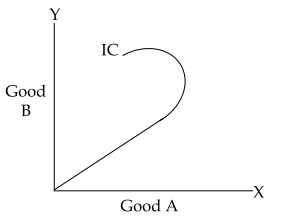
- A consumer spends ₹ 240 when the price of the commodity is ₹ 15 and ₹ 300 when the price rises to ₹ 20. The elasticity of demand is :
Which one of the following demands states consumers are adequately buying all the products put into the marketplace?


