
Understanding Demand Elasticity
The question asks about the relationship between two products when the "gross elasticity of demand" is negative. While "gross elasticity" isn't a standard term, in the context of product relationships and the given options, it strongly implies cross elasticity of demand. This measures how the quantity demanded of one good changes in response to a price change in another good.
Defining Cross Elasticity of Demand
Cross elasticity of demand ($E_{XY}$) is calculated as the percentage change in the quantity demanded of good X divided by the percentage change in the price of good Y. The formula is:
$ E_{XY} = \frac{\% \Delta Q_X}{\% \Delta P_Y} $
The sign of the cross elasticity coefficient tells us about the relationship between the two goods:
- Positive ($E_{XY} > 0$): Indicates that the goods are substitutes. When the price of good Y increases, the demand for good X increases, as consumers switch to the relatively cheaper good X.
- Negative ($E_{XY} < 0$): Indicates that the goods are complements. When the price of good Y increases, the demand for good X decreases, as consumers buy less of both goods together.
- Zero or Near Zero ($E_{XY} \approx 0$): Indicates that the goods are unrelated. A price change in good Y has no significant impact on the demand for good X.
Interpreting Negative Elasticity
The question states that the elasticity is negative. Based on the definition of cross elasticity of demand:
- A negative sign means that as the price of one good (say, good Y) increases, the quantity demanded of the other good (good X) decreases.
- This inverse relationship occurs when the two goods are typically consumed together.
- Therefore, goods with a negative cross elasticity of demand are considered complementary products.
Examples of complementary goods include printers and ink cartridges, or cars and gasoline. If the price of ink cartridges goes up, people might buy fewer printers, or vice versa.
Given that the elasticity is negative, the two products are definitely complementary.
Important Questions from Demand analysis
- For a linear demand curve, which of the following is true ?
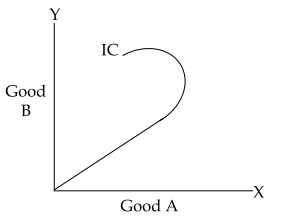
In the above diagram, if curve IC represents income - consumption curve, then it means that :
- A consumer spends ₹ 240 when the price of the commodity is ₹ 15 and ₹ 300 when the price rises to ₹ 20. The elasticity of demand is :
Which one of the following demands states consumers are adequately buying all the products put into the marketplace?
Given below are two statements. one labelled as Assertion (A) and the other labelled as Reason (R).
Assertion (A): Auto companies and other consumer goods companies offer cash rebates to encourage purchase of the manufacturer's products within a specified period
Reason (R): The same product is priced differently at different times
In the context of the two statements above related to pricing strategy, which one of the following options is correct?


