Which one of the following alternatives will perfectly complete the given figure?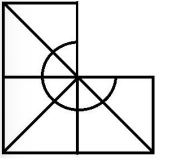

The given problem is about identifying the pattern and selecting the correct figure that perfectly completes the given pattern. Let's break down the components of the given figure:
- The figure is composed of geometric shapes split by lines and arcs.
- Central to the shape is a circle divided by intersecting lines.
- There are straight lines forming triangles within the square spaces.
To find the correct option, we need to identify the missing components that align with this framework. Now, let's examine each option:
- Option 1: This option does not complete the circle correctly and shows incorrect alignment based on the segmentation of the figure.
- Option 2: This option has a pattern different from the original parts visible in the given figure.
- Option 3: This option properly aligns with the existing lines and completes the circle, maintaining the symmetry and distribution of shapes.
- Option 4: This option fails to match the specific angles and arcs observed in the given portion of the figure.
Based on the analysis, Option 3 is the correct answer as it seamlessly completes the pattern by maintaining the structural consistency of the shapes and connections.
Important Questions from Analytical Aptitude
- The assumption that the probability of occurrence of a word in a string depends ONLY on the preceding word is called a ______ assumption.
- Which ONE of the following options represents the correct mapping of the phonetic features in Column X to their Sanskrit equivalents in Column Y?
Column X:
Phonetic featuresColumn Y:
Sanskrit termsP. voicing 1. prāṇa Q. retroflex 2. tālavya R. palatal 3. ghōṣa S. aspiration 4. mūrdhanya - Which ONE of the options represents the CORRECT mapping between the morphological concepts in Column X and the examples in Column Y?
Column X:
Morphological ConceptsColumn Y:
ExamplesP. Suppletion 1. bookmaker – bookie Q. Conversion 2. deer – deer R. Zero morpheme 3. bad – worst S. Hypocorism 4. arrive – arrival T. Derivation 5. (a) doctor – (to) doctor 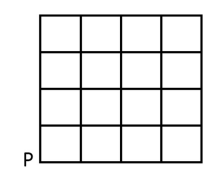
An ant is at the bottom-left corner of a grid (point P) as shown above. It aims to move to the top-right corner of the grid. The ant moves only along the lines marked in the grid such that the current distance to the top-right corner strictly decreases.
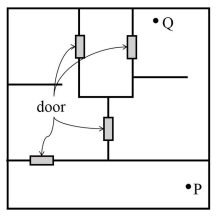
Which one of the following is a part of a possible trajectory of the ant during the movement?A building has several rooms and doors as shown in the top view of the building given below. The doors are closed initially.
What is the minimum number of doors that need to be opened in order to go from the point P to the point Q?