
Understanding Color Blindness Types
Color blindness, or more accurately, color vision deficiency, affects how individuals perceive colors. Different types are characterized by deficiencies in specific cone cells responsible for color perception.
Defining Blue-Yellow Color Deficiency
The question asks to identify the type of color blindness that specifically denotes a blue-yellow colour deficiency. This condition involves difficulty distinguishing between blue and yellow hues, and often includes shades of blue appearing more green, and yellow appearing more reddish or pale.
Analyzing the Options
- Tritanopia: This is a rare form of color blindness where individuals lack the blue-sensitive cone cells (tritanopes). It results in a deficiency in perceiving blue and yellow colors. Blue hues may look greenish, and yellow hues may appear pinkish.
- Protanopia: This type involves the absence of red-sensitive cone cells, leading to difficulty distinguishing between blue and green colors, and reduced sensitivity to red light. It is a form of red-green color blindness.
- Deuteranopia: This involves the absence of green-sensitive cone cells, also resulting in difficulty distinguishing between blue and green colors. It is another form of red-green color blindness.
- Ritalin: This is a brand name for a stimulant medication (methylphenidate) used to treat ADHD and narcolepsy. It is not related to color blindness.
Conclusion on Blue-Yellow Deficiency
Based on the analysis, Tritanopia is the specific type of color vision deficiency characterized by a blue-yellow colour deficiency.
Important Questions from Biological Basis of Behaviour Sensory Systems
Match the numbered parts of the vocal tract (in the diagram given below) with the correct label from those given in the box and choose the appropriate option.
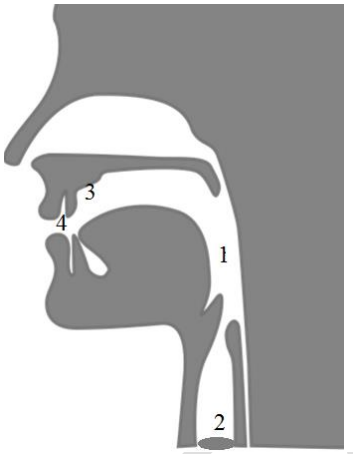
LABELS
a. Labial cavity
b. Pharyngeal cavity
c. Alveolar ridge
d. Laryngeal cavity- In the Darwinian sense, ________ refers to the ability of an organism to survive and produce a large number of fertile offspring.
- Comparing the thoughts of Heraclitus and Parmenides, we can say that:
- In his Yogasūtra, Patañjali mentions five kinds of afflictions (kleśas). Which one of the following is NOT among the five afflictions?
- Devanagari organizes the consonant graphemes as shown in the image. What is the parameter by which the following two rows differ?
क ख ग घ ङ /k/ /kʰ/ /g/ /gʰ/ /ŋ/ प फ ब भ म /p/ /pʰ/ /b/ /bʰ/ /m/


