
Question
Which of these is/are (an) acoustic cue(s) for speech sounds?
Acoustic Cues Explained
Acoustic cues are measurable physical properties of the speech signal that convey linguistic information.
Key Acoustic Cues Identified
The following are recognized acoustic cues essential for speech sound perception:
- Duration: This refers to the length of time a speech sound or segment occupies. Variations in duration are critical for distinguishing between phonemes (e.g., short vs. long vowels) and contribute to the rhythm and timing of speech.
- Fundamental Frequency (F0): This is the lowest frequency component of a complex sound, corresponding to the rate of vocal fold vibration. F0 is the primary determinant of perceived pitch and is crucial for conveying intonation, stress, and emotion in speech.
Analysis of Options
- Option 1: Duration - Correct. As explained above, duration is a fundamental acoustic cue.
- Option 2: Pitch - Related to Fundamental Frequency. While pitch is the perceptual correlate, F0 is the direct acoustic measurement.
- Option 3: Fundamental Frequency - Correct. This is the precise acoustic measure related to pitch and vocal fold vibration rate, serving as a vital cue.
- Option 4: Length - This term is essentially synonymous with Duration in the context of speech sounds. Since 'Duration' is explicitly listed and is the standard term, 'Length' is considered redundant or less precise in this context.
Therefore, 'Duration' and 'Fundamental Frequency' are the primary acoustic cues among the given options.
Was this answer helpful?
Important Questions from Biological Basis of Behaviour Sensory Systems
Match the numbered parts of the vocal tract (in the diagram given below) with the correct label from those given in the box and choose the appropriate option.
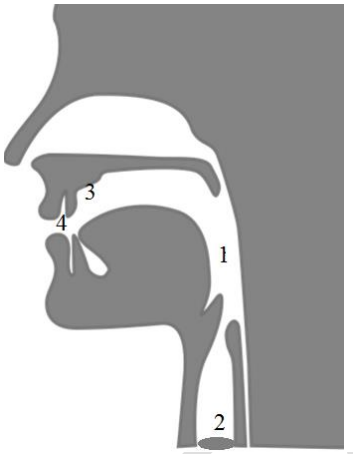
LABELS
a. Labial cavity
b. Pharyngeal cavity
c. Alveolar ridge
d. Laryngeal cavity- In the Darwinian sense, ________ refers to the ability of an organism to survive and produce a large number of fertile offspring.
- Comparing the thoughts of Heraclitus and Parmenides, we can say that:
- In his Yogasūtra, Patañjali mentions five kinds of afflictions (kleśas). Which one of the following is NOT among the five afflictions?
- Devanagari organizes the consonant graphemes as shown in the image. What is the parameter by which the following two rows differ?
क ख ग घ ङ /k/ /kʰ/ /g/ /gʰ/ /ŋ/ प फ ब भ म /p/ /pʰ/ /b/ /bʰ/ /m/
Need Expert Advice?


