
Which of the following statements CANNOT be inferred from the following phylogenetic tree?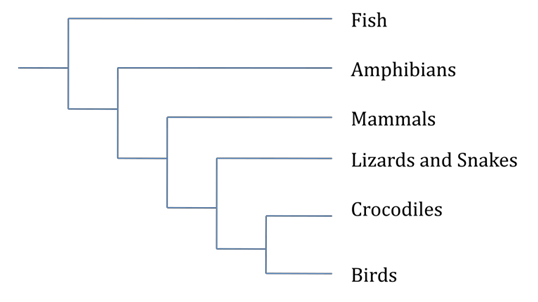
To determine which statement cannot be inferred from the given phylogenetic tree, we have to analyze each option in the context of the evolutionary relationships depicted.
- Crocodiles are more closely related to birds than to the other reptiles:
In the phylogenetic tree, crocodiles and birds share a more recent common ancestor with each other than they do with lizards and snakes. Therefore, this statement can be inferred. - Fish, lizards, and snakes have a common ancestor:
The tree shows a common ancestor from which all depicted species, including fish, lizards, and snakes, are descended. Hence, this statement can also be inferred. - Mammals and reptiles have evolved from amphibians:
The tree shows mammals and reptiles branching away from a common ancestor shared with amphibians, but it doesn't explicitly show mammals and reptiles evolving directly from amphibians. Therefore, this statement cannot be inferred directly from the tree. - Mammals are more closely related to crocodiles than to amphibians:
The tree indicates that mammals and crocodiles share a more recent common ancestor than either does with amphibians. Thus, this statement can be inferred.
Conclusion: The statement that "Mammals and reptiles have evolved from amphibians" cannot be directly inferred from the given phylogenetic tree.
Important Questions from Phylogenetic trees
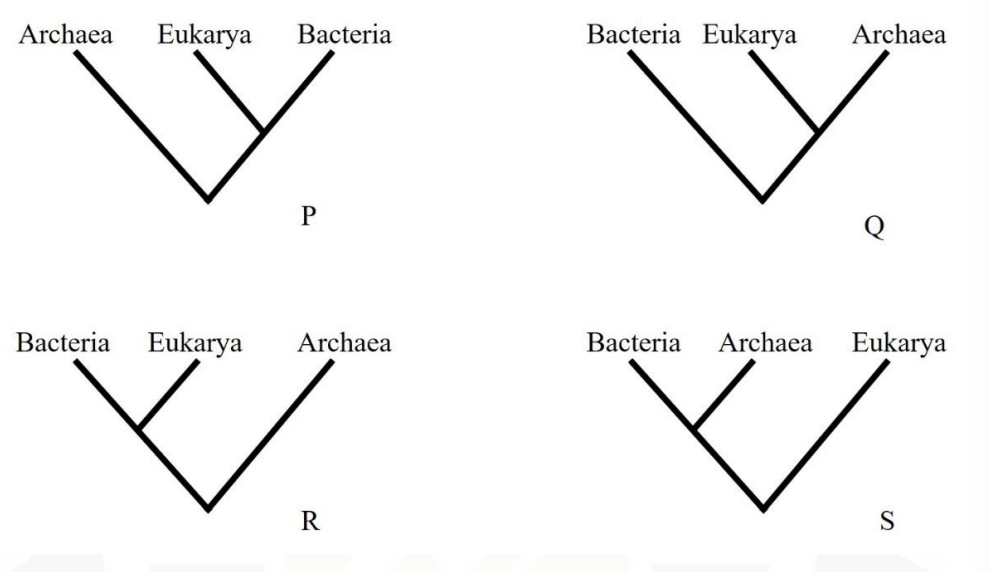
Which one of the following phylogenetic trees illustrates the relationship between Archaea, Bacteria and Eukarya?
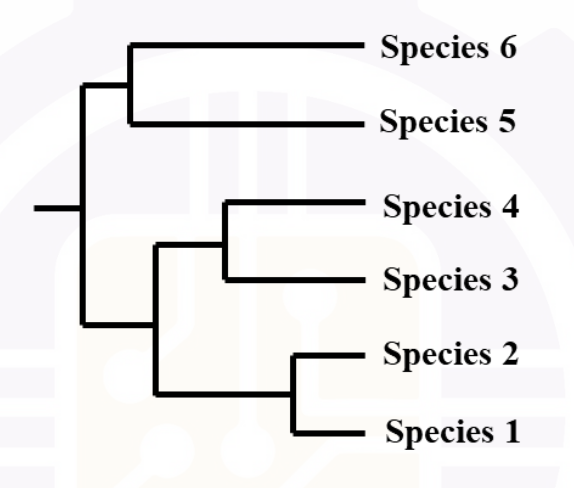
The phylogeny of six species of birds is illustrated below, where the horizontal branch lengths correspond to genetic distance. These six species are distributed in three islands X, Y, and Z. Island X harbours species 1, 4, 6; Island Y harbours species 1, 2, 4; and Island Z harbours species 3, 4, 5. Which one of the following is true about the phylogenetic diversity of these islands?
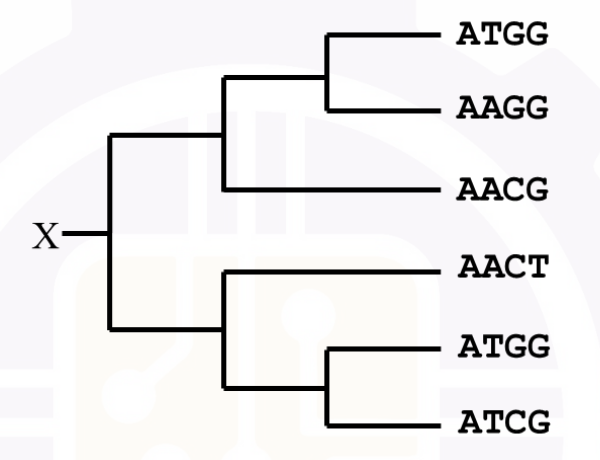
The phylogeny below shows the relationship between six species based on whole genome data. The sequence of a part of a particular gene from each species is provided at the tips of the tree. Based on the principle of parsimony, which one of the following is the expected sequence for the ancestor X?
A phylogenetic tree for the evolution of two pigmentation traits in species of fish is shown for clades X, Y and Z. Genes A and/or B, if mutated, can cause dark pigmentation in the body.
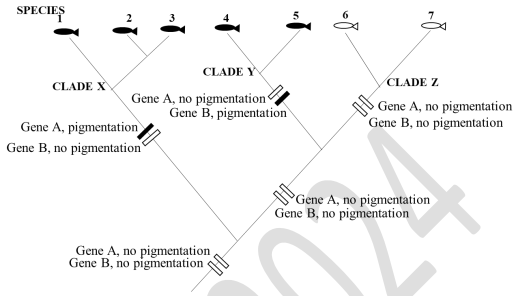
Which one or more of the following statements is/are correct?- Which of the following trees is phylogenetically MOST accurate?


