
Human Evolution: Neanderthal Relationship Explained
This question requires understanding the evolutionary link between modern humans (Homo sapiens) and Neanderthals (Homo neanderthalensis).
Analyzing the Statements
-
Option 1 Incorrect: Modern day humans evolved from Neanderthals.
This is incorrect. While there was interbreeding, modern humans did not descend directly from Neanderthals. They represent distinct lineages that diverged earlier.
-
Option 2 Correct: Modern day humans and Neanderthals share a recent common ancestor.
This statement aligns with current scientific consensus. Both Homo sapiens and Neanderthals evolved from a common hominin ancestor that lived in Africa approximately 500,000 to 800,000 years ago. They are evolutionary cousins, not ancestor and descendant.
-
Option 3 Incorrect: Modern day humans and Neanderthals both evolved from chimpanzees.
This is incorrect. Chimpanzees are our closest living primate relatives, but humans and Neanderthals evolved from much earlier hominin ancestors, long after the lineage leading to humans diverged from the lineage leading to chimpanzees.
-
Option 4 Incorrect: Modern day humans evolved from chimpanzees.
Similar to Option 3, this is incorrect. Humans and chimpanzees share a common ancestor, but humans did not evolve *from* chimpanzees.
Conclusion
The most accurate statement based on evolutionary biology is that modern humans and Neanderthals share a common ancestor.
Important Questions from Phylogenetic trees
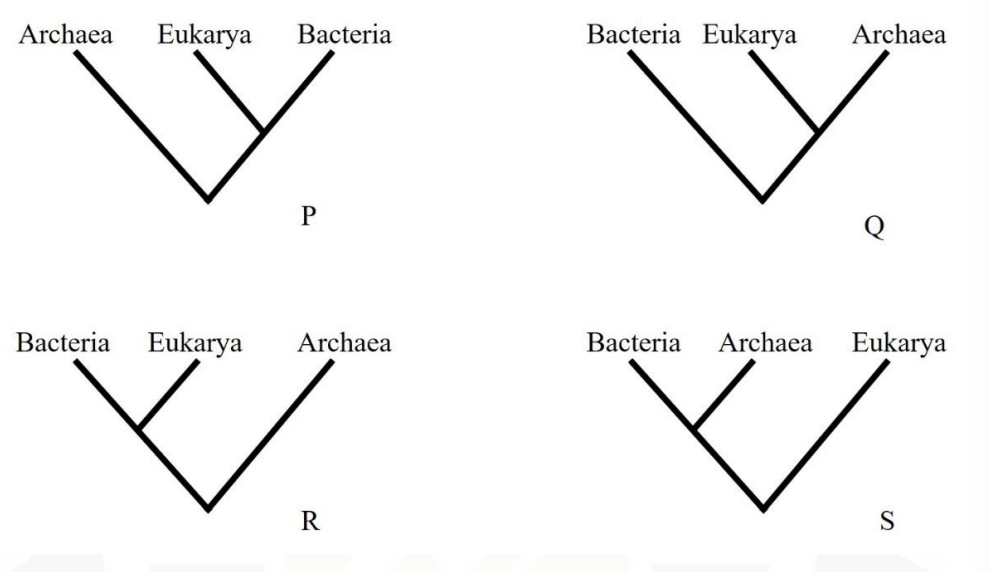
Which one of the following phylogenetic trees illustrates the relationship between Archaea, Bacteria and Eukarya?
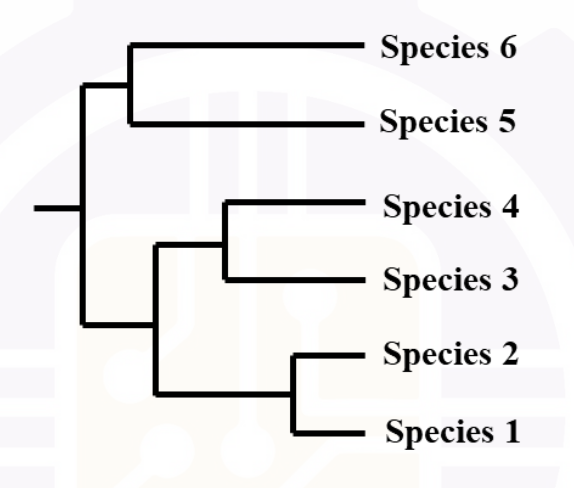
The phylogeny of six species of birds is illustrated below, where the horizontal branch lengths correspond to genetic distance. These six species are distributed in three islands X, Y, and Z. Island X harbours species 1, 4, 6; Island Y harbours species 1, 2, 4; and Island Z harbours species 3, 4, 5. Which one of the following is true about the phylogenetic diversity of these islands?
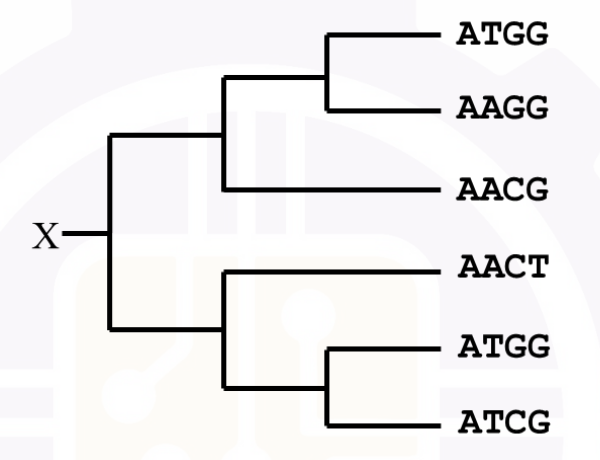
The phylogeny below shows the relationship between six species based on whole genome data. The sequence of a part of a particular gene from each species is provided at the tips of the tree. Based on the principle of parsimony, which one of the following is the expected sequence for the ancestor X?
A phylogenetic tree for the evolution of two pigmentation traits in species of fish is shown for clades X, Y and Z. Genes A and/or B, if mutated, can cause dark pigmentation in the body.
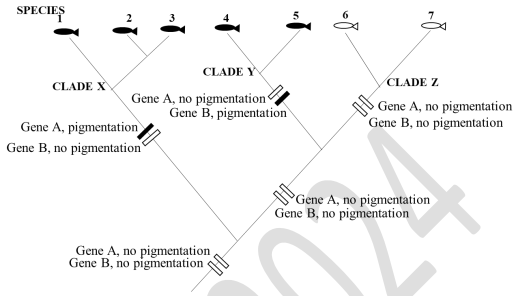
Which one or more of the following statements is/are correct?- Which of the following trees is phylogenetically MOST accurate?


