
Directions : Study the following information and answer the questions given below. Distance and direction between various points is shown in a coded form as follows A # B (58m) – A is 46 m west of B. A & B (89m) – A is 77m south of B. A @ B (110m) – A is 98m north of B. A % B (52m) – A is 40m east of B. N * AB – N is the mid point of line AB. L @ Z (28m), S # K (20m), R % H (17m), Q # Z (26m), T # M (21m), Q & H (22m), S & M (27m), T @ R (28m)
Which of the following statement is sufficient to find shortest distance between points M and J? I. J & P (19m), P % N (22m), N @ O (25m) II. P & Q (27m), N % P (20m), O @ N (22m), O # J (18m)
Understanding the Coded Language
The problem provides a coded language to describe the distance and direction between two points. The code uses symbols like #, &, @, and % followed by a distance in meters (xm). The actual distance and direction are derived from this coded information.
- A # B (xm) means A is (x - 12) m west of B.
- A & B (xm) means A is (x - 12) m south of B.
- A @ B (xm) means A is (x - 12) m north of B.
- A % B (xm) means A is (x - 12) m east of B.
- N * AB means N is the midpoint of line AB.
We need to use these rules to decode the given relations and determine the positions of various points.
Analyzing the Initial Relations
Let's decode the distances and directions from the initial set of relations:
- L @ Z (28m): L is (28 - 12) = 16m north of Z.
- S # K (20m): S is (20 - 12) = 8m west of K.
- R % H (17m): R is (17 - 12) = 5m east of H.
- Q # Z (26m): Q is (26 - 12) = 14m west of Z.
- T # M (21m): T is (21 - 12) = 9m west of M.
- Q & H (22m): Q is (22 - 12) = 10m south of H.
- S & M (27m): S is (27 - 12) = 15m south of M.
- T @ R (28m): T is (28 - 12) = 16m north of R.
To find the shortest distance between M and J, we first need to determine their relative positions. We can establish a coordinate system. Let's place point Z at the origin (0,0).
- Z is at (0,0).
- Q # Z (14m W): Q is 14m west of Z. Q is at (-14, 0).
- Q & H (10m S): Q is 10m south of H, meaning H is 10m north of Q. H is at (-14, 0 + 10) = (-14, 10).
- R % H (5m E): R is 5m east of H. R is at (-14 + 5, 10) = (-9, 10).
- T @ R (16m N): T is 16m north of R. T is at (-9, 10 + 16) = (-9, 26).
- T # M (9m W): T is 9m west of M, meaning M is 9m east of T. M is at (-9 + 9, 26) = (0, 26).
So, the coordinates of point M, based on the initial relations (relative to Z), are (0, 26).
Evaluating Statement I
Statement I provides the following relations:
- J & P (19m): J is (19 - 12) = 7m south of P.
- P % N (22m): P is (22 - 12) = 10m east of N.
- N @ O (25m): N is (25 - 12) = 13m north of O.
These relations describe the positions of points J, P, N, and O relative to each other. However, none of these points (J, P, N, O) are mentioned in the initial set of relations that allowed us to determine the position of M (relative to Z). Therefore, Statement I alone does not provide a link between point J and point M or any point in the initial network (like Z, Q, H, R, T, M). Thus, Statement I alone is not sufficient to find the shortest distance between M and J.
Evaluating Statement II
Statement II provides the following relations:
- P & Q (27m): P is (27 - 12) = 15m south of Q.
- N % P (20m): N is (20 - 12) = 8m east of P.
- O @ N (22m): O is (22 - 12) = 10m north of N.
- O # J (18m): O is (18 - 12) = 6m west of J.
Statement II includes point 'Q', which is part of the initial set of relations. We know the coordinates of Q is (-14, 0) from our previous analysis relative to Z.
Let's use the relations in Statement II starting from point Q:
- Q is at (-14, 0).
- P & Q (15m S): P is 15m south of Q. P is at (-14, 0 - 15) = (-14, -15).
- N % P (8m E): N is 8m east of P. N is at (-14 + 8, -15) = (-6, -15).
- O @ N (10m N): O is 10m north of N. O is at (-6, -15 + 10) = (-6, -5).
- O # J (6m W): O is 6m west of J, meaning J is 6m east of O. J is at (-6 + 6, -5) = (0, -5).
So, using Statement II, we found the coordinates of point J (relative to Z) are (0, -5).
Calculating the Shortest Distance between M and J
From the initial relations, we found M is at (0, 26).
From Statement II, we found J is at (0, -5).
Both points M and J have the same x-coordinate (0). This means they lie on the same vertical line in our coordinate system. The shortest distance between two points on a vertical line is the absolute difference of their y-coordinates.
Shortest Distance (MJ) = |yM - yJ| = |26 - (-5)| = |26 + 5| = |31| = 31 meters.
Since we were able to determine the position of J relative to M (and calculate the distance) using Statement II alone, Statement II is sufficient to answer the question.
Conclusion
Statement I alone is not sufficient to find the shortest distance between M and J because it does not connect to the existing network of points. Statement II alone is sufficient because it connects to the existing network via point Q, allowing us to determine the relative position of J with respect to M and calculate the shortest distance.
Important Questions from Coded direction and Distance
Ravi starts walking towards North. He turns to the right. Then he turns to the left. Hence he turns to the right at an angle of 45 degree. In which direction is he walking now?
Consider a location on the Earth where the Sun is overhead at noon. Compared to its shadow at 10.00 AM, the shadow of a tower at 4.00 PM would be
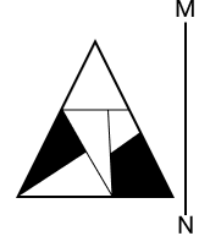
Select the correct mirror image of the given figure when the mirror is placed at MN as shown below.
AT 9 pm, the hour hand faces north, Which direction will the minute hand face at 6.30 am?
If A × B means A is in the South of B, A + B means A is in the North of B, A ÷ B means A is in East of B, A - B means A is in the West of B, then in 'P ÷ Q + R - S' in which direction is S with respect to Q?


