
If A × B means A is in the South of B, A + B means A is in the North of B, A ÷ B means A is in East of B, A - B means A is in the West of B, then in 'P ÷ Q + R - S' in which direction is S with respect to Q?
South-East
Understanding Directional Relationships
This problem is a classic example of a direction sense reasoning question. It requires us to interpret a set of given rules, which define spatial relationships between two points using various symbols, and then apply these rules to a specific expression to determine the final relative position of two points.
First, let's clearly define what each symbol means according to the problem statement:
- A × B: A is in the South of B.
- A + B: A is in the North of B.
- A ÷ B: A is in the East of B.
- A - B: A is in the West of B.
Analyzing the Directional Expression: P ÷ Q + R - S
We are given the expression 'P ÷ Q + R - S' and need to find the direction of S with respect to Q. To solve this, we will break down the expression into its individual parts and establish the relationship between each pair of points.
Step-by-Step Directional Analysis
Let's analyze the relationships sequentially:
- P ÷ Q:
- Applying the rule "A ÷ B means A is in East of B", this statement tells us that P is in the East of Q.
- If we consider Q as our reference point, P is located to its right.
- Q + R:
- Applying the rule "A + B means A is in the North of B", this statement tells us that Q is in the North of R.
- This relationship also means that R is in the South of Q. So, if Q is above R.
- R - S:
- Applying the rule "A - B means A is in the West of B", this statement tells us that R is in the West of S.
- This means that S is in the East of R. So, if R is to the left of S.
Determining S's Position Relative to Q
Now, let's combine these individual relationships to determine the direction of S with respect to Q. We will start from Q and trace the path to S based on the established relative positions.
From our analysis, we have two key relationships that connect Q to S via R:
- R is in the South of Q.
- S is in the East of R.
To visualize this:
- Imagine placing Q at the center of a coordinate system.
- Since R is in the South of Q, you would move downwards from Q to reach R.
- From R, S is in the East. So, from R, you would move to the right to reach S.
| Point | Relationship | Direction from Previous Point |
|---|---|---|
| R | Q is North of R (R is South of Q) | South of Q |
| S | R is West of S (S is East of R) | East of R |
If you start at Q, move South to get to R, and then move East from R to get to S, the final position of S from Q is in the South-East direction. Consider Q as the origin \((0,0)\). Moving South places you at a point like \((0, -y)\). Moving East from there places you at \((x, -y)\), which clearly represents a South-East position relative to the origin.
Therefore, S is in the South-East direction with respect to Q.
Important Questions from Coded direction and Distance
Ravi starts walking towards North. He turns to the right. Then he turns to the left. Hence he turns to the right at an angle of 45 degree. In which direction is he walking now?
Consider a location on the Earth where the Sun is overhead at noon. Compared to its shadow at 10.00 AM, the shadow of a tower at 4.00 PM would be
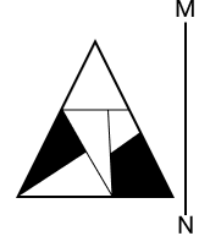
Select the correct mirror image of the given figure when the mirror is placed at MN as shown below.
AT 9 pm, the hour hand faces north, Which direction will the minute hand face at 6.30 am?
Which of the following statement is sufficient to find shortest distance between points M and J?
I. J & P (19m), P % N (22m), N @ O (25m)
II. P & Q (27m), N % P (20m), O @ N (22m), O # J (18m)


