
Phyla Closest to Chordates
The question asks to identify the phylum most closely related to Chordates from the given options. Evolutionary relationships are often determined by shared developmental patterns and genetic similarities.
Deuterostome Connection
Chordates belong to the superphylum Deuterostomia. Within this group, organisms share key embryonic features. Phylogenetic analyses show that the phylum Echinodermata (which includes starfish, sea urchins, and sea cucumbers) is the closest relative to chordates.
- Both chordates and echinoderms are deuterostomes.
- Key deuterostome features include radial cleavage and the anus forming from the blastopore.
Protostome Contrasts
The remaining options belong to the superphylum Protostomia:
- Annelida (segmented worms)
- Arthropoda (insects, crustaceans, etc.)
- Mollusca (snails, squids, etc.)
Protostomes have different developmental patterns (e.g., spiral cleavage, mouth forming from the blastopore). Since Echinodermata shares the deuterostome classification with Chordata, it is considered the most closely related phylum among the choices.
Important Questions from Phylogenetic trees
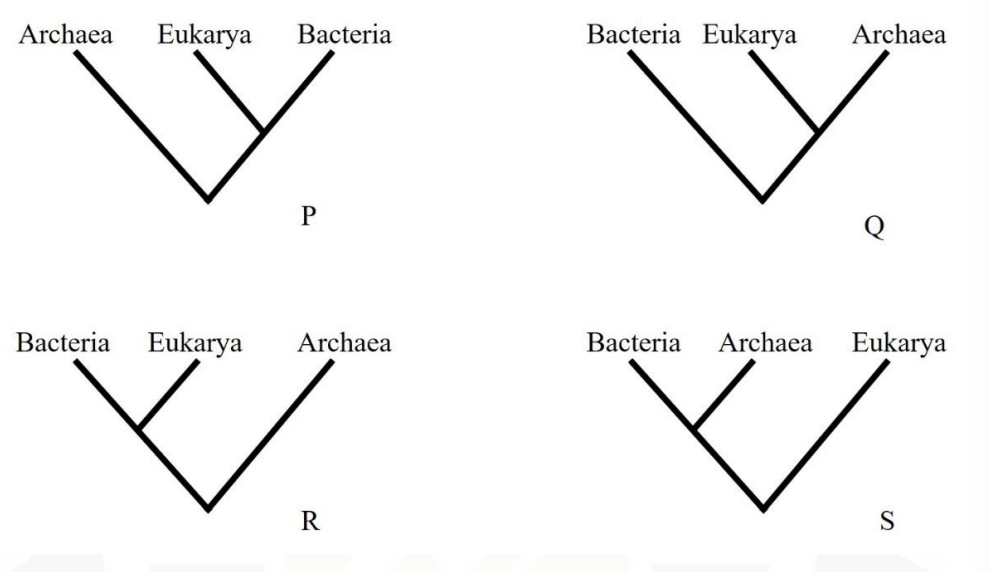
Which one of the following phylogenetic trees illustrates the relationship between Archaea, Bacteria and Eukarya?
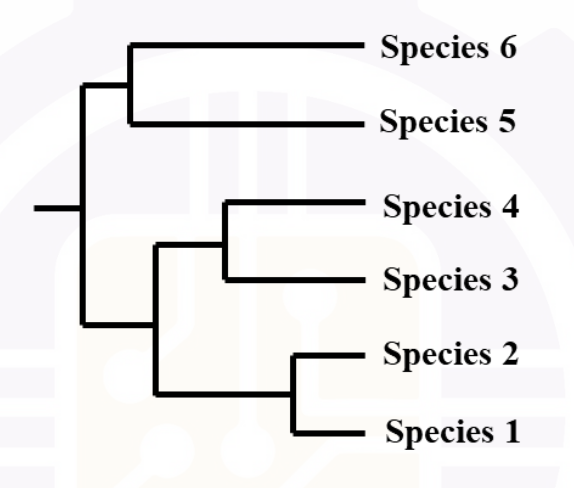
The phylogeny of six species of birds is illustrated below, where the horizontal branch lengths correspond to genetic distance. These six species are distributed in three islands X, Y, and Z. Island X harbours species 1, 4, 6; Island Y harbours species 1, 2, 4; and Island Z harbours species 3, 4, 5. Which one of the following is true about the phylogenetic diversity of these islands?
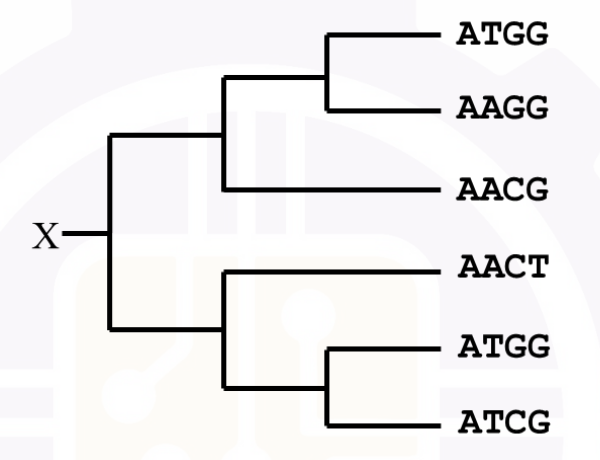
The phylogeny below shows the relationship between six species based on whole genome data. The sequence of a part of a particular gene from each species is provided at the tips of the tree. Based on the principle of parsimony, which one of the following is the expected sequence for the ancestor X?
A phylogenetic tree for the evolution of two pigmentation traits in species of fish is shown for clades X, Y and Z. Genes A and/or B, if mutated, can cause dark pigmentation in the body.
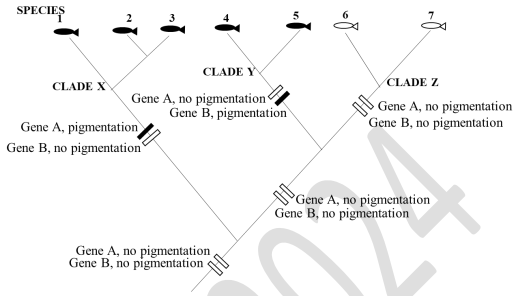
Which one or more of the following statements is/are correct?- Which of the following trees is phylogenetically MOST accurate?


