
Which of the following options is true?
Active filters are smaller and less heavy in size
Understanding Active and Passive Filters
Filters are essential electronic circuits designed to pass certain frequencies while attenuating others. They are widely used in various electronic applications, from audio systems to communication circuits. Filters can be broadly categorized into two main types: passive filters and active filters. Understanding the fundamental differences between these two types is crucial for selecting the appropriate filter for a specific application.
Passive Filters Explained
Passive filters are electronic filters that are constructed using only passive components. These components include resistors $\left( \text{R} \right)$, capacitors $\left( \text{C} \right)$, and inductors $\left( \text{L} \right)$.
- No External Power: Passive filters do not require an external power supply to operate. They simply shape the frequency response of a signal based on the properties of their passive components.
- Component Size and Weight: At lower frequencies, inductors and capacitors often need to be physically large to achieve the desired impedance or resonance. This can make passive filters, especially those requiring inductors, quite bulky and heavy.
- Gain Limitation: Passive filters cannot provide any signal gain; in fact, they typically introduce some amount of insertion loss (signal attenuation) because of energy dissipation in resistive elements.
- Frequency Response: They generally have limited control over their frequency response characteristics, such as the steepness of the roll-off or the Q factor, compared to active filters.
Active Filters Explained
Active filters, on the other hand, incorporate active components in addition to passive ones. The most common active components used in these filters are operational amplifiers $\left( \text{op-amps} \right)$ and transistors.
- External Power Required: Active filters require an external power supply to power the active components, such as op-amps, which are essential for their operation.
- Smaller and Lighter Size: A significant advantage of active filters is that they often eliminate the need for bulky and heavy inductors. The filtering action and frequency response shaping are primarily achieved using op-amps, resistors, and capacitors. This allows active filters to be designed in a much smaller and lighter footprint compared to passive filters with similar performance.
- Gain Capability: Active filters can provide signal gain, meaning they can amplify the desired frequencies while filtering others. This is a crucial advantage in many applications.
- Improved Performance: They offer greater flexibility and precision in controlling the filter's characteristics, such as sharper roll-offs, higher Q factors, and easier adjustability.
Analyzing the Options
Let's evaluate each given option based on the characteristics of passive and active filters:
- Option 1: Passive filters provide excellent resolution
This statement is generally false. While passive filters can achieve filtering, active filters typically offer better resolution in terms of sharper cutoff frequencies, higher Q values, and more precise control over the filter's response, without the physical bulk associated with passive components for high performance. - Option 2: Active filters are smaller and less heavy in size
This statement is true. As explained, active filters can achieve filtering without the need for large inductors, which are often bulky and heavy in passive designs. The use of op-amps and smaller passive components allows for more compact and lighter circuit designs. - Option 3: Passive filters have op-amp and transistors
This statement is false. By definition, passive filters use only passive components (resistors, capacitors, inductors). Op-amps and transistors are active components, which are characteristic of active filters. - Option 4: Passive filters are smaller in size and less heavy
This statement is false. As discussed, passive filters, particularly those designed for lower frequencies or high-performance applications, often require large inductor and capacitor values, making them significantly larger and heavier than their active counterparts.
Conclusion
Based on the detailed comparison, the statement that active filters are smaller and less heavy in size is correct. This is a key advantage of active filter designs in modern electronics, contributing to the miniaturization of devices.
Important Questions from Filters
The active filter works well
A band pass filter response has :
(a) Two critical frequencies
(b) Quality factor depends on the center frequency and the bandwidth
(c) Quality factor depends on the critical frequencies
(d) A voltage gainOptions :
A phase locked loop (PLL) consists of :
Which among the following has a frequency selective amplifier whose gain decreases from a finite value to zero as the frequency of the sinusoidal input increases from dc to infinity?
The direct form structure of an FIR (finite impulse response) filter is shown in the figure.
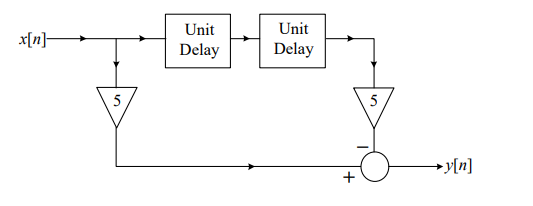
The filter can be used to approximate a


