
Which among the following has a frequency selective amplifier whose gain decreases from a finite value to zero as the frequency of the sinusoidal input increases from dc to infinity?
low pass filter
Understanding Frequency Selective Amplifiers
The question describes a circuit that acts as a frequency selective amplifier. This means its gain, which is the ratio of output voltage to input voltage, changes depending on the frequency of the input signal. The specific characteristic mentioned is that the gain starts at a finite value at zero frequency (DC) and decreases towards zero as the frequency increases to infinity.
Analyzing the Options
Let's examine each option based on its typical frequency response:
- Low Pass Filter: A low pass filter is designed to pass low frequencies and attenuate (reduce the amplitude of) high frequencies. At DC (\(f = 0\)), an ideal low pass filter has maximum gain (often 1, or some finite value greater than 1 if it includes amplification). As the frequency increases, the gain decreases, eventually rolling off towards zero at very high frequencies (\(f \to \infty\)). This behavior perfectly matches the description given in the question.
- Differentiator Circuit: A differentiator circuit's output is proportional to the derivative of the input signal. In the frequency domain, this corresponds to a gain that increases linearly with frequency. The gain is zero at DC and increases with frequency, which is the opposite of the behavior described.
- Leaky Integrator: An integrator circuit's output is proportional to the integral of the input signal. An ideal integrator has infinite gain at DC, and the gain decreases as frequency increases. A "leaky" integrator, often implemented with a resistor in parallel with the feedback capacitor in an op-amp circuit, behaves similarly to a low-pass filter. It has a finite gain at DC (determined by the feedback resistor) and the gain decreases with increasing frequency, rolling off towards zero at very high frequencies. While a leaky integrator exhibits the described gain versus frequency characteristic (finite DC gain, decreasing to zero at infinite frequency), "low pass filter" is the more general and standard term for a circuit designed specifically for this frequency response characteristic. The question asks which "among the following" has this characteristic, and a low pass filter is the primary example.
- Voltage Follower: A voltage follower (also known as a buffer) is designed to have a voltage gain of approximately 1 across a wide range of frequencies. While its gain might decrease slightly at very high frequencies due to practical limitations (like op-amp bandwidth), its primary function is not frequency selective attenuation in the manner described. Its gain does not typically decrease significantly from a finite value (near 1) all the way to zero as frequency increases from DC to infinity; it aims to maintain a gain near 1 over its operating range.
Based on the analysis, the circuit whose gain decreases from a finite value at DC to zero as frequency increases to infinity is characteristic of a low pass filter.
Important Questions from Filters
The active filter works well
A band pass filter response has :
(a) Two critical frequencies
(b) Quality factor depends on the center frequency and the bandwidth
(c) Quality factor depends on the critical frequencies
(d) A voltage gainOptions :
A phase locked loop (PLL) consists of :
The direct form structure of an FIR (finite impulse response) filter is shown in the figure.
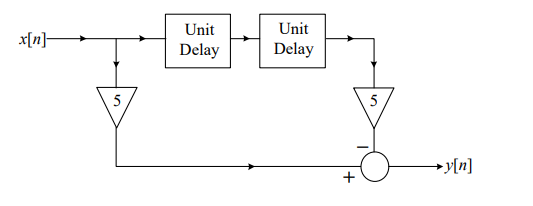
The filter can be used to approximate a
Which of the following options is true?


