
Which of the following interchange of signs would make the given equation correct? 42 ÷ 7 − 64 + 11 × 6 = 4
+ and −
Equation Solving with Sign Interchange
The problem asks us to find which interchange of arithmetic signs ($+$, $-$, $\times$, $\div$) in the given equation will make the equation mathematically correct. The original equation is:
42 ÷ 7 − 64 + 11 × 6 = 4
We need to test each given option by swapping the specified signs and then evaluating the resulting expression using the order of operations (BODMAS/PEMDAS: Brackets, Orders/Exponents, Division and Multiplication (from left to right), Addition and Subtraction (from left to right)).
Testing Each Sign Interchange Option
Option 1: Interchange ÷ and −
Swap $\div$ and $-$ in the equation. The equation becomes:
42 − 7 ÷ 64 + 11 × 6
Let's evaluate this expression:
- First, Division: $\frac{7}{64}$. This does not result in a whole number.
- The expression is $42 - \frac{7}{64} + 11 \times 6$.
- Next, Multiplication: $11 \times 6 = 66$.
- The expression is $42 - \frac{7}{64} + 66$.
- $42 + 66 - \frac{7}{64} = 108 - \frac{7}{64}$. This is not equal to 4.
So, interchanging $\div$ and $-$ does not make the equation correct.
Option 2: Interchange × and +
Swap $\times$ and $+$ in the equation. The equation becomes:
42 ÷ 7 − 64 × 11 + 6
Let's evaluate this expression:
- First, Division: $42 \div 7 = 6$.
- The expression is $6 - 64 \times 11 + 6$.
- Next, Multiplication: $64 \times 11 = 704$.
- The expression is $6 - 704 + 6$.
- Now, Addition and Subtraction from left to right: $6 - 704 = -698$.
- Then, $-698 + 6 = -692$.
The result is $-692$, which is not equal to 4. So, interchanging $\times$ and $+$ does not make the equation correct.
Option 3: Interchange × and −
Swap $\times$ and $-$ in the equation. The equation becomes:
42 ÷ 7 × 64 + 11 − 6
Let's evaluate this expression:
- First, Division: $42 \div 7 = 6$.
- The expression is $6 \times 64 + 11 - 6$.
- Next, Multiplication: $6 \times 64 = 384$.
- The expression is $384 + 11 - 6$.
- Now, Addition and Subtraction from left to right: $384 + 11 = 395$.
- Then, $395 - 6 = 389$.
The result is $389$, which is not equal to 4. So, interchanging $\times$ and $-$ does not make the equation correct.
Option 4: Interchange + and −
Swap $+$ and $-$ in the equation. The equation becomes:
42 ÷ 7 + 64 − 11 × 6
Let's evaluate this expression:
- First, Division: $42 \div 7 = 6$.
- The expression is $6 + 64 - 11 \times 6$.
- Next, Multiplication: $11 \times 6 = 66$.
- The expression is $6 + 64 - 66$.
- Now, Addition and Subtraction from left to right: $6 + 64 = 70$.
- Then, $70 - 66 = 4$.
The result is $4$, which is equal to the right side of the original equation. So, interchanging $+$ and $-$ makes the equation correct.
Conclusion on Sign Interchange
After testing all the given options for interchanging signs, we found that swapping the $+$ and $-$ signs in the original equation 42 ÷ 7 − 64 + 11 × 6 = 4 results in the correct mathematical statement 42 ÷ 7 + 64 − 11 × 6 = 4.
Revision Table: Order of Operations
When evaluating mathematical expressions, always follow the standard order of operations:
| Order | Operation Type | Mnemonic (e.g., BODMAS/PEMDAS) |
|---|---|---|
| 1st | Brackets / Parentheses | B / P |
| 2nd | Orders / Exponents / Indices | O / E / I |
| 3rd | Division and Multiplication (from left to right) | DM |
| 4th | Addition and Subtraction (from left to right) | AS |
Additional Information: Importance of Sign Interchange Problems
Problems involving the interchange of signs are common in logical reasoning and quantitative aptitude tests. They check your ability to follow rules, perform calculations accurately, and systematically test possibilities. Understanding the order of operations is crucial to solve these types of problems correctly. Practice with different equations and sign combinations can improve speed and accuracy.
Similar Questions
If 85 × 5 - 3 = 20 and 18 × 2 - 1 = 10, then 100 × 20 - 5 = ?
By interchanging which two signs the equation will be correct?
25 + 18 ÷ 2 - 4 = 20What will come in place of question mark (?) in the given equation?
9 ? 11 ? 6 ? 3 ? 9 = 117Which two numbers from amongst the given options should be interchanged to make the given equation correct?
(36 ÷ 2) × 5 – 15 × 4 = 20 − 260 ÷ (5 × 3 + 2)
Which two numbers from amongst the given options should be interchanged to make the given equation correct?
(357 ÷ 2 + 3) ÷ 11 − 4 = (28 × 3 + 7) ÷ 9
If + means – , – means ×, × means ÷ and ÷ means +, then what will come in place of ? in the given equation?
7 ÷ 20 – 5 × 20 + 2 = ?
If ‘A’ is replaced by ‘ + ’; if ‘B’ is replaced by ‘ - ’; ‘C’ is replaced by ‘ ÷ ’; and ‘D’ is replaced by ‘ × ’, then find the value of the following equation.
20A15C3D8B9Find out the two signs to be interchanged for making following equation correct.
5 + 3 × 4 – 12 ÷ 2 = - 1If ‘A’ is replaced by ‘+’; If ‘B’ is replaced by ‘-’; ‘C’ is replaced by ‘÷’, and ‘D’ is replaced by ‘×’, find the value of the following equation.
51 C 17 D 15 A 22 B 34In the following question, different letters stand for various symbols as indicated below:
A. Multiplication
B. Division
C. Addition
D. Subtraction
E. Equal to
F. Greater than
G. Less than
Identify the correct one according to the symbols given in the directions.
Important Questions from Logical Puzzle
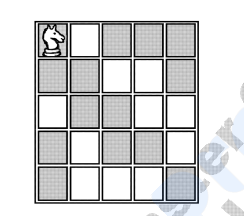
Below is given a figure, in which a horse is placed on one of the boxes in a square grid of size $5 \times 5$. The horse can move in either of the following ways in a single move:
(i) two boxes to either left or right side and one box to either up or down side
(ii) two boxes to either up or down side and one box to either left or right side
(iii) the horse cannot step on a grey box. The horse has to stay within the grid and any move to out of the grid is NOT legal.
How many white boxes are there which cannot be covered by horse within 3 moves?
- Six persons Raj, Rohit, Rachit, Rajat, Rishu, and Rinku are working in an office. Each of them has a favorite car viz. P, Q, R, S, T, and U, but not necessarily in the same order. Each of them got a different salary - 1000, 2000, 2500, 3000, 3500, and 4000, but not necessarily in the same order. Rajat gets a salary of 2500 and his favorite car is U. The one who likes car Q gets a salary of 3000. Rachit likes car P and gets a salary of 3500. The one who gets a salary of 1000 does not like car R or S. Rinku does not like car Q or S but gets a salary of 2000. Rishu gets a salary of 4000 and does not like a car R. Rohit does not get a salary of 1000. Who gets a salary of 3000?
- Six friends P, Q, R, S, T, and U are sitting at different positions in a row of the company, and each of them get a different salary viz – 500, 800, 1000, 1500, 1800 & 2000, but not necessary in the same order. The friend who gets a salary of 2000 does not sit at the extreme end of the row. Q sits immediately before R and gets a salary of 800. T sits between U and S. Q is second to the left of S. P sits at the left end of the row and gets a salary of 1000. T gets a salary of 1500. R gets a salary neither of 2000 nor of 1800. How much salary does U get?
- Seven men A, B, C, D, E, F and G are standing in a queue, one behind the other in that order. That is, A is first in queue while G brings up the rear. Each of them is wearing a hat of a different colour of the rainbow - Violet, Indigo, Blue, Green, Yellow, Orange, and Red, but not necessarily in that order. It is also known that:
• D can see in front of him green and blue hats, but not the violet hat.
• E can see violet and yellow hats, but not the red hat.
• G can see hats of all the colours except Orange.
• E is wearing the Indigo coloured hat.
What colour hat is worn by F? - Who amongst the females arrived third?



