
If ‘A’ is replaced by ‘+’; If ‘B’ is replaced by ‘-’; ‘C’ is replaced by ‘÷’, and ‘D’ is replaced by ‘×’, find the value of the following equation.
33
Solving Symbol Replacement Mathematical Equations
This problem requires us to find the value of a given expression by replacing letters with mathematical operators according to the defined rules. We are given the expression '51 C 17 D 15 A 22 B 34' and the following replacements:
- ‘A’ is replaced by ‘+’ (addition)
- ‘B’ is replaced by ‘-’ (subtraction)
- ‘C’ is replaced by ‘÷’ (division)
- ‘D’ is replaced by ‘×’ (multiplication)
Replacing Symbols in the Expression
Let's substitute the letters in the expression '51 C 17 D 15 A 22 B 34' with their corresponding mathematical operators:
The expression becomes: 51 $\div$ 17 $\times$ 15 + 22 - 34
Evaluating the Expression Using Order of Operations
Now we need to evaluate the new expression using the standard order of operations, often remembered by the acronym BODMAS or PEMDAS. The order is typically:
- Brackets (Parentheses)
- Orders (Exponents, Roots)
- Division and Multiplication (from left to right)
- Addition and Subtraction (from left to right)
Let's solve the expression step by step:
The expression is: 51 $\div$ 17 $\times$ 15 + 22 - 34
Step 1: Perform Division
According to BODMAS/PEMDAS, we perform division first.
51 $\div$ 17 = 3
The expression now is: 3 $\times$ 15 + 22 - 34
Step 2: Perform Multiplication
Next, we perform multiplication.
3 $\times$ 15 = 45
The expression now is: 45 + 22 - 34
Step 3: Perform Addition and Subtraction (from left to right)
Now we perform addition and subtraction from left to right.
First, addition:
45 + 22 = 67
The expression now is: 67 - 34
Finally, subtraction:
67 - 34 = 33
Final Value of the Equation
The value of the expression 51 C 17 D 15 A 22 B 34, after replacing the symbols and following the order of operations, is 33.
Revision Table: Symbol Replacement Rules
| Original Symbol | Replacement Operator | Meaning |
|---|---|---|
| A | + | Addition |
| B | - | Subtraction |
| C | $\div$ | Division |
| D | $\times$ | Multiplication |
Additional Information: Understanding Order of Operations
The order of operations (BODMAS/PEMDAS) is crucial for solving mathematical expressions correctly, especially those involving multiple operations. Failing to follow the correct order can lead to incorrect results. Remember that Division and Multiplication have equal priority and should be performed from left to right as they appear. Similarly, Addition and Subtraction have equal priority and are performed from left to right.
Another mnemonic used in some regions is PEMDAS:
- P - Parentheses
- E - Exponents
- M - Multiplication
- D - Division
- A - Addition
- S - Subtraction
Both BODMAS and PEMDAS represent the same order of operations, just with slightly different naming (e.g., Brackets vs. Parentheses, Orders/Exponents vs. Exponents). The key is consistency and performing multiplication/division before addition/subtraction, and working from left to right for operations of the same priority.
Similar Questions
If 85 × 5 - 3 = 20 and 18 × 2 - 1 = 10, then 100 × 20 - 5 = ?
By interchanging which two signs the equation will be correct?
25 + 18 ÷ 2 - 4 = 20What will come in place of question mark (?) in the given equation?
9 ? 11 ? 6 ? 3 ? 9 = 117Which two numbers from amongst the given options should be interchanged to make the given equation correct?
(36 ÷ 2) × 5 – 15 × 4 = 20 − 260 ÷ (5 × 3 + 2)
Which two numbers from amongst the given options should be interchanged to make the given equation correct?
(357 ÷ 2 + 3) ÷ 11 − 4 = (28 × 3 + 7) ÷ 9
If + means – , – means ×, × means ÷ and ÷ means +, then what will come in place of ? in the given equation?
7 ÷ 20 – 5 × 20 + 2 = ?
Which of the following interchange of signs would make the given equation correct?
42 ÷ 7 − 64 + 11 × 6 = 4
If ‘A’ is replaced by ‘ + ’; if ‘B’ is replaced by ‘ - ’; ‘C’ is replaced by ‘ ÷ ’; and ‘D’ is replaced by ‘ × ’, then find the value of the following equation.
20A15C3D8B9Find out the two signs to be interchanged for making following equation correct.
5 + 3 × 4 – 12 ÷ 2 = - 1In the following question, different letters stand for various symbols as indicated below:
A. Multiplication
B. Division
C. Addition
D. Subtraction
E. Equal to
F. Greater than
G. Less than
Identify the correct one according to the symbols given in the directions.
Important Questions from Logical Puzzle
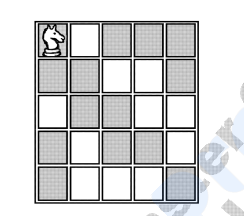
Below is given a figure, in which a horse is placed on one of the boxes in a square grid of size $5 \times 5$. The horse can move in either of the following ways in a single move:
(i) two boxes to either left or right side and one box to either up or down side
(ii) two boxes to either up or down side and one box to either left or right side
(iii) the horse cannot step on a grey box. The horse has to stay within the grid and any move to out of the grid is NOT legal.
How many white boxes are there which cannot be covered by horse within 3 moves?
- Six persons Raj, Rohit, Rachit, Rajat, Rishu, and Rinku are working in an office. Each of them has a favorite car viz. P, Q, R, S, T, and U, but not necessarily in the same order. Each of them got a different salary - 1000, 2000, 2500, 3000, 3500, and 4000, but not necessarily in the same order. Rajat gets a salary of 2500 and his favorite car is U. The one who likes car Q gets a salary of 3000. Rachit likes car P and gets a salary of 3500. The one who gets a salary of 1000 does not like car R or S. Rinku does not like car Q or S but gets a salary of 2000. Rishu gets a salary of 4000 and does not like a car R. Rohit does not get a salary of 1000. Who gets a salary of 3000?
- Six friends P, Q, R, S, T, and U are sitting at different positions in a row of the company, and each of them get a different salary viz – 500, 800, 1000, 1500, 1800 & 2000, but not necessary in the same order. The friend who gets a salary of 2000 does not sit at the extreme end of the row. Q sits immediately before R and gets a salary of 800. T sits between U and S. Q is second to the left of S. P sits at the left end of the row and gets a salary of 1000. T gets a salary of 1500. R gets a salary neither of 2000 nor of 1800. How much salary does U get?
- Seven men A, B, C, D, E, F and G are standing in a queue, one behind the other in that order. That is, A is first in queue while G brings up the rear. Each of them is wearing a hat of a different colour of the rainbow - Violet, Indigo, Blue, Green, Yellow, Orange, and Red, but not necessarily in that order. It is also known that:
• D can see in front of him green and blue hats, but not the violet hat.
• E can see violet and yellow hats, but not the red hat.
• G can see hats of all the colours except Orange.
• E is wearing the Indigo coloured hat.
What colour hat is worn by F? - Who amongst the females arrived third?



