
Which one of the Mill's methods is used here for arriving at the conclusion?
Identifying Mill's Method of Agreement
The problem describes a situation where specific symptoms observed in a pet, Johny (sniffing food, not eating, urinating near the plate), are linked to a potential cause (diabetes) based on a study. The conclusion that Johny has diabetes is drawn by matching Johny's specific set of symptoms to the condition described in the study.
Applying Mill's Methods
John Stuart Mill proposed several methods for inductive reasoning. Let's analyze which one fits this scenario:
- Method of Agreement: This method states that if two or more instances of an event have only one circumstance in common, then that circumstance is the probable cause of the event. In this case, the observed 'event' is Johny's sickness symptoms, and the 'common circumstance' (identified via the study) that aligns with these symptoms is diabetes. The owner uses this single point of agreement to conclude diabetes.
- Method of Difference: This method compares a case where the phenomenon occurs with one where it does not, looking for the single differing factor. This is not used here as there's no comparison with a healthy state of Johny.
- Method of Concomitant Variation: This involves observing how a phenomenon changes in degree as another phenomenon changes. The symptoms described are not shown to vary in intensity.
- Method of Residues: This involves removing known causes and attributing the remaining effect to unknown causes. This method is not applicable here.
The reasoning directly follows the structure of the Method of Agreement: The specific behavior (circumstance) observed in Johny matches the behavior identified in the study as indicative of diabetes (cause). Therefore, the conclusion is based on this agreement.
Important Questions from Logical Deduction
- Based only on the conversation below, identify the logically correct inference:
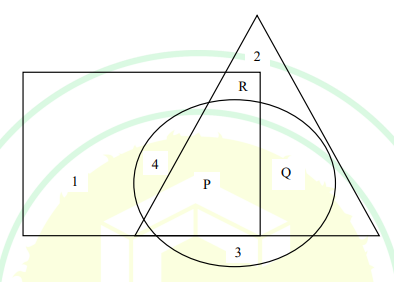
“Even if I had known that you were in the hospital, I would not have gone there to see you", Ramya told Josephine. In the given figure, the numbers associated with the rectangle, triangle, and ellipse are 1, 2, and 3, respectively. Which one among the given options is the most appropriate combination of P, Q, and R ?
- Column-I has statements made by Shanthala; and, Column-II has responses given by Kanishk.
Column-I Column-II P. This house is in a mess. 1. Alright, I won't bring it up during our conversations. Q. I am not happy with the marks given to me. 2. Well, you can easily look it up. R. Politics is a subject I avoid talking about. 3. No problem, let me clear it up for you. S. I don't know what this word means. 4. Don't worry, I will take it up with your teacher.
Identify the option that has the correct match between Column-I and Column-II. - In the following truth table, what does X stand for?
P Q X 1 1 1 1 0 0 0 1 0 0 0 1 A color model is shown in the figure with color codes: Yellow (Y), Magenta (M), Cyan (Cy), Red (R), Blue (Bl), Green (G), and Black (K).
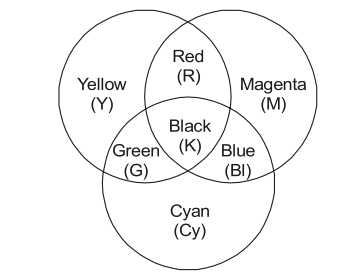
Which one of the following options displays the color codes that are consistent with the color model?


