
In the given figure, the numbers associated with the rectangle, triangle, and ellipse are 1, 2, and 3, respectively. Which one among the given options is the most appropriate combination of P, Q, and R ?
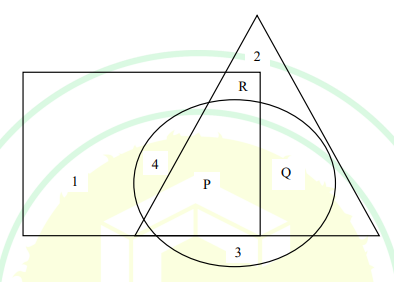
To find the most appropriate combination of P, Q, and R, we analyze which numbers fall into specific regions of the Venn diagram represented by the rectangle, triangle, and ellipse.
The numbers associated with each shape are:
- Rectangle: 1
- Triangle: 2
- Ellipse: 3
The regions in the Venn diagram are as follows:
- P: Inside the ellipse only
- Q: Inside both triangle and ellipse
- R: Inside both rectangle and triangle, but outside the ellipse
Now, let us determine the numbers for P, Q, and R:
- P: The number that is in the overlap of the triangle and ellipse is 6. Therefore, P = 6.
- Q: The only number inside the triangle and the ellipse (but not exclusively in either) is 5. So, Q = 5.
- R: The number in the overlap of the rectangle and triangle (but outside the ellipse) is 3. Hence, R = 3.
After placing these numbers into their respective positions:
| Shape | Region | Number |
|---|---|---|
| Ellipse | P | 6 |
| Triangle & Ellipse | Q | 5 |
| Rectangle & Triangle | R | 3 |
The correct combination is:
P = 6; Q = 5; R = 3
Therefore, the most appropriate answer is the option: P = 6; Q = 5; R = 3.
Important Questions from Logical Deduction
- Consider the following two phonological rules:
Rule 1: Vowel Epenthesis of [ɪ] after sibilant-ending stems
Rule 2: Progressive Voicing Assimilation of the plural affix
Which ONE of the following rule ordering relations apply in the case of regular English pluralization as in ‘horse’ – ‘horses’? - Based only on the conversation below, identify the logically correct inference:
“Even if I had known that you were in the hospital, I would not have gone there to see you", Ramya told Josephine. Consider a five-digit number PQRST that has distinct digits P, Q, R, S and T, and satisfies the following conditions:
$P < Q$
$S > P > T$
$R < T$
If integers 1 through 5 are used to construct such a number, the value of P is:Residency is a famous housing complex with many well-established individuals among its residents. A recent survey conducted among the residents of the complex revealed that all of those residents who are well established in their respective fields happen to be academicians. The survey also revealed that most of these academicians are authors of some best-selling books.
Based only on the information provided above, which one of the following statements can be logically inferred with certainty?- The police arrested four criminals – P, Q, R and S. The criminals knew each other. They made the following statements:
P says "Q committed the crime.”
Q says "S committed the crime. "
R says"I did not do it."
S says "What Q said about me is false."
Assume only one of the arrested four committed the crime and only one of the statements made above is true. Who committed the crime?


