
Question
When income effect becomes stronger than substitution effect, the labour supply curve will
The correct answer is
Bend backward
Labour Supply Curve: Income & Substitution Effects
The shape of the labour supply curve is determined by how individuals respond to changes in the wage rate, considering both the substitution and income effects.
- Substitution Effect: A higher wage rate makes leisure more expensive (opportunity cost increases). This encourages workers to supply more labor (substitute work for leisure).
- Income Effect: A higher wage rate increases a worker's income. If leisure is a normal good, this higher income allows workers to afford more leisure, encouraging them to work less.
These effects move in opposite directions.
Backward Bending Curve Dynamics
The question states a scenario where the income effect is stronger than the substitution effect. Mathematically, this is represented as $\text{IE} > \text{SE}$.
In this specific case:
- At lower wage rates, the substitution effect typically dominates, causing the labour supply curve to slope upwards (more work supplied as wages rise).
- However, beyond a certain wage threshold, the stronger income effect takes over. Workers feel rich enough to reduce working hours and enjoy more leisure, despite the higher wage.
This change in dominance leads to the characteristic backward bending shape of the labour supply curve.
Was this answer helpful?
Important Questions from Consumer behaviour
In the above diagram, the consumer surplus is represented by the area of :
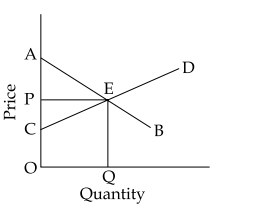
- Organization responsible for preventing unfair or deceptive trade practices in textile and textile products is :
- The urge to possess and consume for display of wealth is called :
- Which of the following factors favour fashion ?
(a) Leisure
(b) An economy of abundance
(c) Transportation and communication
(d) Low income
(e) Sumptuary laws
Code : - Arrange the following Acts in the ascending order of their years of enactment :
(a) Environmental Protection Act
(b) MRTP
(c) PFA
(d) ISI Certification Marks Act
(e) Air Pollution Act
Need Expert Advice?


