
Role of National Parks Under Wildlife Protection Act, 1972
The Wildlife Protection Act, 1972 is a crucial piece of legislation enacted in India to ensure the protection and conservation of the country's rich biodiversity. This Act establishes various categories of protected areas, with National Parks being one of the most significant.
Understanding the Core Function of National Parks
The primary and most vital role of National Parks under the Wildlife Protection Act, 1972, is centered around the conservation of wildlife and the preservation of their natural habitats. This involves:
- Safeguarding all species of fauna (animals) and flora (plants) residing within their defined boundaries.
- Protecting the overall ecosystem and landscape features characteristic of the area.
- Ensuring that the habitats are maintained in a pristine condition, free from human disturbance, exploitation, and encroachment, which is essential for the survival and breeding of wildlife.
Key Restrictions within National Parks
To fulfill their protective role, National Parks have stringent regulations:
- Activities like grazing, forestry, and collection of forest produce are generally prohibited.
- Human settlement and activities that could impact wildlife or their environment are strictly controlled or disallowed.
- The focus remains on maintaining the area as a natural habitat and a sanctuary for wildlife.
Evaluating Other Options
While National Parks often become destinations for tourism, this is a secondary outcome and not their primary legal purpose under the Act. Regulating trade is a function addressed by other sections of the Act or different legislation. Overseeing elections is entirely unrelated to wildlife conservation.
Conclusion
In essence, the designation of an area as a National Park under the Wildlife Protection Act, 1972, signifies a commitment to the highest level of protection for wildlife and their environments.
Similar Questions
- Name the state in whichThe Bhitarkanika Mangroves are located?
Important Questions from National Parks of India
Consider the following pairs:
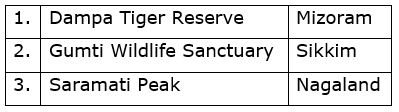
Which of the above pairs is/are correctly matched?
Consider the following pairs:
1. Nokrek Biosphere Reserve Garo Hills
2. Logtak (Loktak) Lake Barail Range
3. Namdapha National Park Dafla Hills
Which of the above pairs is/are correctly matched?
Consider the following pairs:
National Park River flowing through the Park
1. Corbett National Park Ganga
2. Kaziranga National Park Manas
3. Silent Valley National Park Kaveri
Which of the above pairs is/are correctly mached?
Which one of the following National Parks has a climate that varies from tropical to subtropical, temperate and arctic?
Sariska and Ranthambore are the reserves for which of the following



