
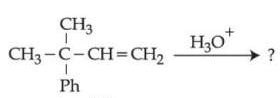
 product formed is:
Step 1: Understanding the Reaction Mechanism
- The reaction involves the **acid-catalyzed hydration** of an alkene (**H3O+**).
- The key rule followed is **Markovnikov’s Rule**, which states that the proton (H⁺) adds to the carbon with the greater number of hydrogens, while OH⁻ attaches to the more substituted carbon.
Step 2: Formation of the Carbocation
- Protonation of the double bond leads to the formation of a **more stable tertiary carbocation** due to rearrangement.
Step 3: Nucleophilic Attack by H2O
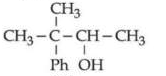
- Water attacks the carbocation, leading to the formation of an **alcohol (-OH) at the more substituted carbon**.
Step 4: Identifying the Correct Product
- The **correct structure** corresponds to **option (a)**, where the OH group is placed at the **tertiary carbon adjacent to the phenyl (Ph) group**, following Markovnikov's rule.
Thus, the correct answer is **(a)**.
Important Questions from Chemical Kinetics
A reaction takes 30 minutes to complete 50% of the reaction and takes 45 minutes to complete 75% of the reaction. The order of the reaction is:
Ferric oxide in blast furnace's upper half is mainly reduced by:
If time taken for a first-order reaction to get 90% complete is 24 min, its t99.9% will be:
Match the Items List-I and List-II:
List-I List-II (A) Instantaneous Rate (I) Rate constant (B) Average Rate (II) Rate law (C) Mathematical expression for rate of reaction in terms of concentration of reactants (III) Short interval of time (D) Rate of reaction for zero-order reaction is equal to (IV) Long direction of time Choose the correct answer from the options given below:
Identify the correct relation between the molar mass of solute and Ebullioscopic constant.


